
Honduras Introduces Smart Vehicle Licence Plates from Tönnjes
- New production facility will be installed in Honduras
- Modern security technology to improve vehicle identification
- Integrated digital platform enables real-time RFID data readout and traffic-fine tracking
Tegucigalpa, Honduras, 22.07.2026. The government of President Nasry Asfura has signed a contract for the introduction of smart vehicle licence plates in Honduras. Over the next three and a half years, the German company Tönnjes will supply the country with smart, RFID-based licence plates and the associated security technology.
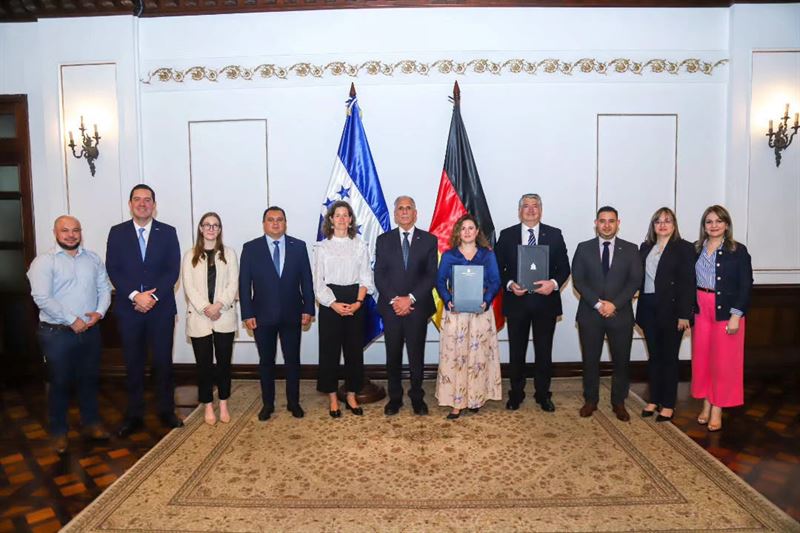 Group photo, from left: David Colman, procurement consultant at the Instituto de la Propiedad, IP; Emilio Hernández Hércules, Honduran finance minister; Stephanie Paysen, Tönnjes managing director in Honduras; Luis Alonso Castro Cáceres, private secretary to the president; Daniela Vogl, German ambassador; President Nasry Asfura; Lucía Mausen, Tönnjes; Juan Carlos García, presidential minister; Luis Torres, IP executive secretary; Bessy Alvarado, IP vehicle registry director; and Gloria Mendoza, IP legal adviser and project coordinator. (Copyright Tönnjes)
The contract was signed by Juan Carlos García, Minister of the Presidency, on behalf of the Instituto de la Propiedad, and by Lucía Mausen, Sales Director for Latin America and the Caribbean of the responsible Tönnjes subsidiary, on behalf of the company. President Nasry Asfura attended the ceremony as guest of honour, together with the German Ambassador to Honduras, Daniela Vogl.
The contract's aim is to clear a backlog of more than one million outstanding licence plates and to meet projected demand through 2030. In total, the project covers approximately 2.9 million smart licence plates and the related RFID security stickers.
The shortage of metal licence plates has affected Honduran vehicle owners for several years: since 2023, hundreds of thousands of drivers have had to rely on provisional paper permits while waiting for permanent plates. The new agreement is designed to clear this backlog and put licence plate supply on a stable, long-term footing.
A key element of the agreement is the construction of a production facility in Honduras. The facility is expected to create jobs.
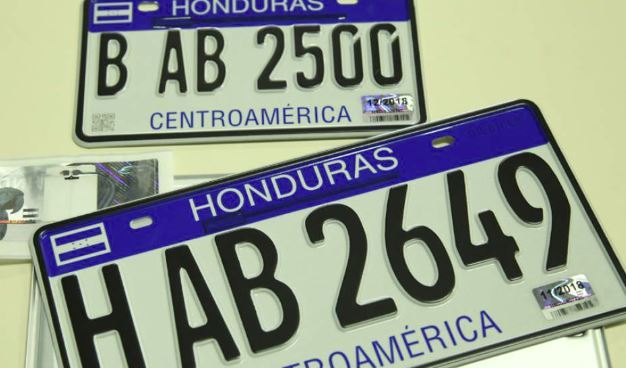
New Honduran number plates with RFID-label. (Copyright Tönnjes)
The new licence plates will use RFID technology and digital authentication systems, with the data read out and processed through a central digital platform. This platform will give the Instituto de la Propiedad and other public authorities real-time access to vehicle information, including the ability to flag outstanding traffic fines and other pending matters linked to a registered vehicle. In addition, a security sticker – often referred to in the industry as a "third plate" – will be attached to the windscreen or, on two-wheelers, to the headlamp. This combination of technologies will make it easier to identify vehicles, prevent counterfeiting and strengthen the control systems used by public authorities and the emergency response centre.
According to the Instituto de la Propiedad, the provisional paper licence plates that many drivers have had to rely on for several years can now be gradually replaced. Nationwide distribution of the new metal plates is expected to begin shortly.
"This project combines modern security technology with local value creation and provides a long-term solution for vehicle registration in the country."
— Lucía Mausen, Sales Director Latin America and the Caribbean of the responsible Tönnjes subsidiary.
By introducing smart licence plates, Honduras is taking a major step towards modernising its vehicle identification systems while establishing the foundations for secure and efficient domestic licence plate production.
About TÖNNJES INTERNATIONAL GROUP GmbH
TÖNNJES INTERNATIONAL GROUP is the global market leader in secure vehicle identification and offers governments and authorities worldwide innovative system solutions for vehicle registration.
As a technology leader, TÖNNJES offers a complete range of services, from the production of secure licence plates to the development and implementation of intelligent registration software.
The portfolio includes patented technologies such as RFID-enabled licence plates, which make vehicles tamper-proof, forgery-proof, and automatically identifiable.
With over 50 locations worldwide, a global partner network, subsidiaries, and around 2,000 employees, TÖNNJES is a global partner for governments and authorities in more than 120 countries. Countries around the world rely on the expertise and technology of TÖNNJES INTERNATIONAL GROUP.
For further information: www.toennjes.com
Press contact:
Dederichs Reinecke & Partner
Simon Lenke
E-Mail: simon.lenke@dr-p.de
Tel: +49 1716103081