Following the U.S. FDA De Novo Classification, Amferia Seeks Potential Partners to Market the World’s First Antibacterial Peptide-Based Wound Dressing
With the FDA De Novo Classification granted, Swedish medtech firm Amferia now seeks partners to bring the first-ever wound care product featuring antibacterial peptides as the mechanism for fighting infection to the U.S. market. The decision creates a new regulatory category for wound dressings in the U.S.
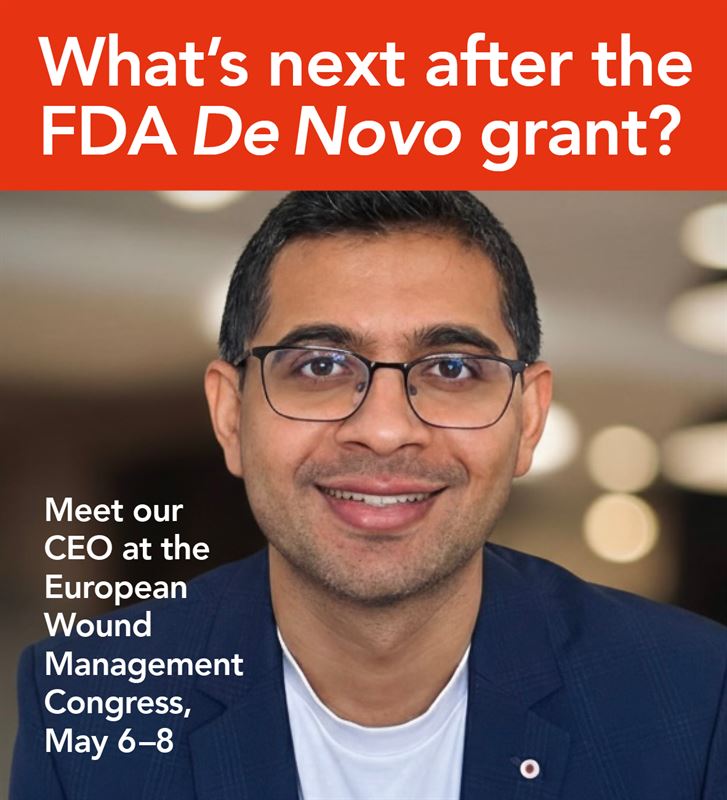
GOTHENBURG, SWEDEN—Following approval by the U.S. Food and Drug Administration (FDA) for its antibacterial wound dressing, Amferia representatives will attend the European Wound Management (EWMA) Congress in Bremen, Germany, May 6-8, 2026, to discuss expansion of its products into the U.S. market.
In February, Amferia was granted the De Novo Classification from the FDA, allowing the company to enter the U.S. market with a unique Class 2 medical device antibacterial dressing for advanced wound care, according to Amferia CEO and Co-Founder Anand Rajasekharan. The approval creates a new regulatory category for wound dressings, in which Amferia’s is the only approved product.
“The FDA approval has changed the landscape for Amferia,” said Rajasekharan. “After years of studies and development, now our attention turns to exploring how best to bring Amferia products to the U.S. market.
“Very few De Novo applications are granted by the FDA. The fact that ours was signifies how unique the technology is. We’re looking for partners who have the capabilities to move into this new market.”
The FDA’s decision positions Amferia as a strategic partner for established wound care companies seeking next-generation antimicrobial solutions that align with evolving regulatory and safety expectations. Amferia’s technology is also positioned at a time when healthcare system looks towards reducing their reliance on silver. Silver has long been a mainstay as an antimicrobial in wound care, but commodification of silver, growing bacterial resistance to it, and changing landscape on reimbursement have the healthcare system and industry looking for innovative new tools to address infections.
Amferia’s FDA approval positions it as one of those novel tools for antimicrobial wound care. Rajasekharan said he hopes the EWMA Congress will provide opportunities for Amferia representatives to meet with potential partners and discuss next steps and timelines.
Separately, Amferia is readying clinical data to begin the approval process for human care within the European Union. The company expects heightened interest from industry partners and has built a family of patents designed to allow the expansion of its peptide-based technology beyond wound care over time.
Amferia’s patented technology is a hydrogel permanently bonded with peptides, which kill pathogenic bacteria by drawing them close and physically puncturing their cell membranes. Even antibiotic-resistant bacteria cannot effectively resist this interaction.
To confirm the dressing’s efficacy and safety for FDA regulators, Amferia was obliged to provide clinical documentation that their novel mode of action kills 99.99% of bacteria exposed to it without releasing active substances into the wound or the body.
The FDA’s grant of Amferia’s innovation establishes a new regulatory category for wound dressings and enables a unique and powerful tool in the worldwide battle against wound infection.
“This De Novo grant validates years of scientific and regulatory work,” said Rajasekharan. “More importantly, it opens the door to safer, more sustainable ways to fight infection—at a time when the need for new antimicrobial strategies has never been greater.
“Bacterial infections are likely to surpass cancer and heart disease as a number one cause of human deaths in the future, and this is largely due to resistance to commonly used antibiotics. Our hydrogel technology enables the safe and stable use of antimicrobial peptides, allowing them to effectively target bacteria without harming surrounding tissue.”
Studies demonstrate that, in addition to effectively killing a broad spectrum of bacteria including antibiotic-resistant bacteria, Amferia dressings help support moist wound healing.
A Deliberate, Data-Driven Path to Approval
Early engagement with the FDA made clear that Amferia’s wound dressing was too novel to be reviewed through the traditional 510(k) pathway, which compares new treatments to existing products and determines if they are substantially equivalent. Since no anti-bacterial peptide based wound dressings currently exist on the U.S. market, Amferia pursued the De Novo classification pathway—designed for low-to-moderate risk devices that are new to the market but can be demonstrated safe and effective through clinical test results.
Amferia worked closely with FDA reviewers to generate an extensive body of evidence addressing questions of safety, effectiveness, and risk mitigation. Laboratory tests proved that Amferia’s wound dressings meet the FDA’s stringent requirement that wound dressings calling themselves anti-bacterial kill at least 99.99% of bacteria they are exposed to. Advanced chemical analyses proved that the peptides remain permanently bound to the hydrogel and do not leach into surrounding wound or tissue.
At several points, FDA feedback resulted in additional testing requests, including expanded bacterial strain panels and further in-vivo safety studies. Amferia responded point-by-point, generating new data and refining its submission. Throughout the process, the FDA did not challenge the underlying science of the technology, focusing instead on ensuring that the novel mechanism could be clearly understood, reproducibly tested, and safely regulated.
The Race to Solve Global Antimicrobial Resistance
Antimicrobial resistance (AMR) is accelerating at a pace that threatens to become one of the leading causes of human mortality worldwide in coming decades. At least five million people are currently affected by infections caused by antibiotic resistance. In countries with a high incidence of resistant bacteria, a small wound can cause life-threatening infection that can’t be treated with traditional antibiotics.
Antimicrobial peptides are known for their ability to kill bacteria due to their positive electrostatic charge, which attracts the negatively charged infectious bacteria. This allows peptides to puncture bacterial membranes and destroy the cells. However, their fragility in biological environments has been a major challenge to developing peptides as a viable treatment—naturally occurring enzymes in the body can destroy them within seconds. The Amferia hydrogel technology solves that problem.
Amferia’s breakthrough is the development of a hydrogel platform, encasing the peptides in a solid protective gel. This design shields the vulnerable facets of peptides while allowing their bacteria-killing structures to remain exposed—and lethal to even antibiotic-resistant bacteria. Amferia's antimicrobial hydrogel kills bacteria without harming surrounding body tissue.
“The hydrogel technology we’ve developed enables the safe and stable use of antimicrobial peptides—one of nature’s most powerful defenses—while preventing the enzyme degradation that has historically limited their use,” Rajasekharan said.
Research shows that combining Amferia’s peptide hydrogel platfrom with antibiotics can dramatically amplify their bactericidal effect—up to 64 times stronger—demonstrating its potential to reshape infection management.
At scale, the Amferia approach has the potential to reduce infection rates, lower healthcare costs, and provide new options for treating wounds where conventional antimicrobials are becoming less effective.
Amferia has already entered the animal health segment and signed commercial agreements with leading animal health companies in Europe, to introduce a wound dressing that also kills resistant bacteria and is now expanding into new markets with further partnerships in the pipeline.
In December, 2025, Amferia announced the successful closure of a 3.5-million-euro investment round. The round was over-prescribed and spearheaded by existing owners and new investors, among whom are leading voices in wound care.
Looking Ahead
Amferia continues to expand its product pipeline, invest in research, and collaborate with global partners to redefine how infections are prevented and managed. By stabilizing one of nature’s most effective bacterial defenses, the company offers a transformative platform with the potential to strengthen antibiotic treatments and improve outcomes across healthcare.
Learn more about Amferia
https://www.amferia.com/
https://news.cision.com/amferia-ab/r/new-study-finds-innovative-peptide-hydrogel-restores-the-effectiveness-of-antibiotics-against-drug-r,c4067581
https://news.cision.com/amferia-ab/r/first-product-utilizing-amferia-antimicrobial-technology-launched-in-europe-for-animal-wound-care,c4058570
https://news.cision.com/amferia-ab/r/amferia-wins-red-dot-award-for-innovative-design-addressing-bacterial-infections-and-antibiotic-resi,c4063979
Contact
Anand Rajasekharan
CEO & Co-Founder, Amferia
+46 76 298 12 38
anandk@amferia.com