
Concrete in road tunnels decomposes unexpectedly fast
When seawater penetrates concrete in road tunnels, a biofilm is formed that breaks down the concrete. This can lead to high costs and the risk of damage if stone and concrete drop from the tunnel roof. In a new study, led by a team of researchers at Chalmers University of Technology in Sweden, research reveals the mechanisms behind the degradation, and its unexpectedly rapid progression.
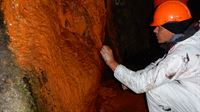
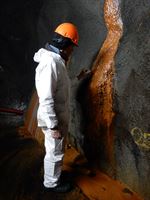
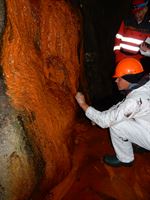
When vehicle tunnels are constructed through rock, the roof and walls are sprayed with concrete to create an even surface layer and prevent stones from loosening and falling onto the road. When the tunnels are surrounded by seawater, as in the Oslofjord, for example, a well-known and problematic phenomenon occurs, ‘saltwater intrusion’. This is a process which carries bacteria into the tunnel environment and these bacteria then form colonies – biofilms – on the surface of the concrete. The bacteria feed on substances in the concrete and attack the surface, which becomes damaged and porous as a result. In a recent scientific publication, the researchers have discovered new insights about the microbiological processes behind the degradation, and that is happening relatively fast.
"We have been taking measurements in the Oslofjord tunnel since 2014, and we can see that the bacteria eat their way into the concrete surface up to one centimetre a year. Where there is saltwater intrusion, a biofilm will form, and the concrete covered by the biofilm will gradually dissolve," says Frank Persson, Associate Professor of Molecular Biology and Microbial Ecology at Chalmers' Department of Architecture and Civil Engineering.
Fouling of biofilm not unique to Norwegian tunnels
Sprayed concrete has been used in road tunnels on a larger scale since the 1990s, and since then, researchers have been able to see this fouling of biofilm. Despite this, there are currently very few similar studies of biocorrosion in underwater tunnels in marine environments.
Frank Persson and his colleagues have investigated the Oslofjord tunnel in projects linked to the Swedish Transport Administration's Norwegian counterpart, the Norwegian Public Roads Administration, but according to the researchers, the phenomenon probably occurs in similar environments around the world.
New concrete sprayed on walls and ceilings in tunnels has a high pH value, but as the concrete ages, a natural chemical degradation occurs, which causes the pH value of the concrete to drop and makes the environment more hospitable to bacteria. The bacteria further accelerate the corrosion of the concrete reinforcement and in turn, the degradation of the concrete itself, when they metabolise iron, manganese, sulphur and nitrogen in the concrete. The researchers have seen that this interacting degradation locally can be relatively fast. Under extreme conditions, the bacteria can penetrate up to 10 cm in five years.
"This type of biofilm is a pretty clear warning signal. You need to monitor the water flow and the spread of the biofilm and locate loose and damaged concrete to spray again, if necessary," says Britt-Marie Wilén, Professor of Environmental and Wastewater Engineering at Chalmers Department of Architecture and Civil Engineering.
The researchers emphasise that road tunnels, despite this biofilm, are generally safe and are monitored by Norwegian authorities. Their recommendation based on the studies is to measure the pH value of the concrete continuously, examine the groundwater flow through the rock and to monitor the spread of the biofilm. The groundwater flow affects the growth of biofilm, especially at lower flows, where the pH value of the biofilm is lower, which contributes to faster degradation of the concrete than at a higher groundwater flow that neutralises the acid in the biofilm.
The current research has been carried out in the Oslofjord tunnel in Norway, but similar degradation of the concrete is likely to also occur in similar tunnels where freshwater is able to leach into the concrete, according to Britt-Marie Wilén.
"However, the problem is probably greater in environments where seawater penetrates, partly because seawater is favourable for bacterial growth but also because the salt accelerates corrosion in the reinforcement. Climate change is also making the oceans warmer, and with warmer water, the pH value drops further, which could increase the rate of corrosion," she says.
By mapping the microbial communities in the Oslofjord tunnel, the Chalmers researchers have revealed new, previously unknown microorganisms**. New techniques for DNA sequencing and processing of data have also offered completely new opportunities to interpret and understand what has been found.
More about the study
The study, "Microbial acidification by N, S, Fe and Mn oxidation as a key mechanism for deterioration of subsea tunnel sprayed concrete" was published in Nature Scientific Reports.
The authors are Sabina Karačić, Carolina Suarez, Per Hagelia*, Frank Persson, Oskar Modin, Paula Dalcin Martins and Britt-Marie Wilén. First author Sabina Karačić At the time of the study, he was a doctoral student at Chalmers but is no longer active at the department.
*Currently retired from the Norwegian Public Roads Administration
**During the course of their work, the researchers have discovered Anammoxibacteraceae, a new family of anammox bacteria, which metabolises nitrogen. The discovery provides new information about how nitrogen is metabolised in nature. See previous scientific publication.
For more information, please contact
Britt-Marie Wilén, Professor, Department of Architecture and Civil Engineering, Chalmers University of Technology, Sweden.
+46 31 772 21 53, britt-marie.wilen@chalmers.se
The contact persons speak English and Swedish. They are available for live and pre-recorded interviews. At Chalmers, we have podcast studios and broadcast filming equipment on site and would be able to assist a request for a television, radio or podcast interview.
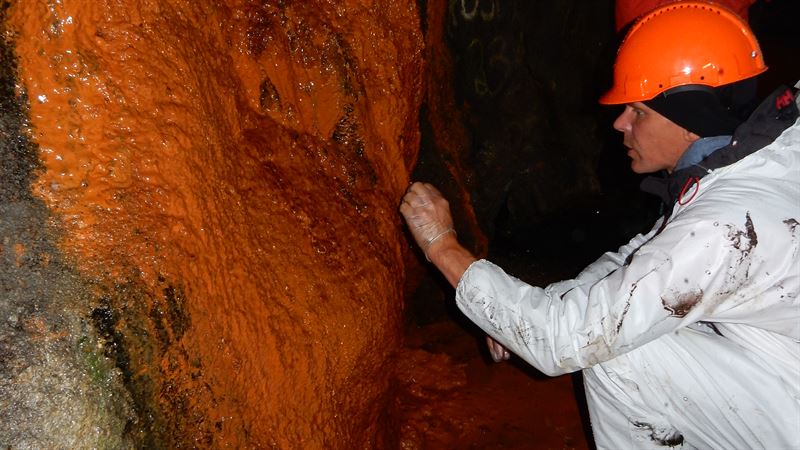
Banner image caption: Penetrating seawater carries bacteria that form colonies – biofilm. The bacteria attack the concrete that is supposed to prevent stones from loosening from the tunnel walls. The concrete becomes porous and risks breaking apart. The biofilm gets its distinctive colour from rusting reinforcement in the shotcrete.
Banner image credit: Chalmers University of Technology I Britt-Marie Wilén
Emma FryPress Officer+46 31 772 50 28emma.fry@chalmers.se________________
Chalmers University of Technology in Gothenburg, Sweden, conducts research and education in technology and natural sciences at a high international level. The university has 3100 employees and 10,000 students, and offers education in engineering, science, shipping and architecture.
With scientific excellence as a basis, Chalmers promotes knowledge and technical solutions for a sustainable world. Through global commitment and entrepreneurship, we foster an innovative spirit, in close collaboration with wider society.
Chalmers was founded in 1829 and has the same motto today as it did then: Avancez – forward.
---
Images provided in Chalmers University of Technology press releases are, unless specified otherwise, free for download and publication as long as credit is given to the University and the individual creator. Cropping and rescaling of the images is permitted when required for adaptation to the publication’s format, but modifications that would influence the message and content of the original are not. The material is primarily intended for journalistic and informative use, to assist in communication and coverage of Chalmers’ research and education. Commercial usage, for example the marketing of goods and services, is not permitted.
We kindly request credit to be given in the following format where possible:
Image/Graphic/Illustration: Chalmers University of Technology | Name Surname