

Contrails are a major driver of aviation’s climate impact
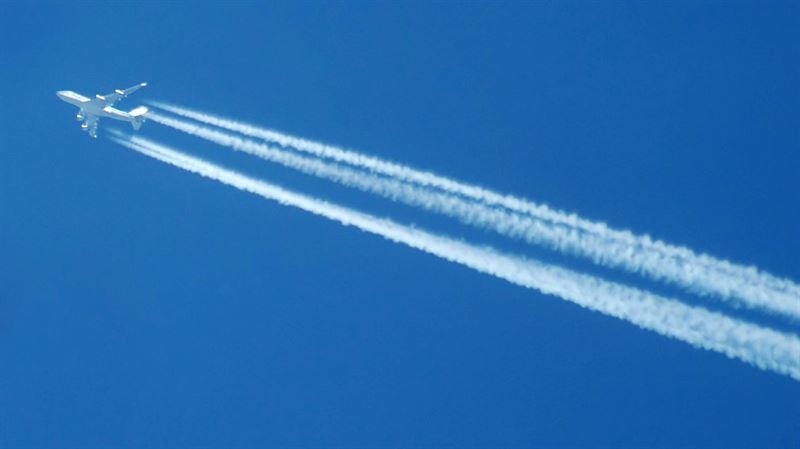
Aviation’s climate impact extends beyond carbon dioxide emissions. A new study from Chalmers University of Technology and the University of Gothenburg, Sweden, and Imperial College, UK, reveals that contrails can represent a significant portion of aviation’s overall climate cost. The study also shows that climate impact can be reduced by optimising flight routes.
In a new article in Nature Communications, The social costs of aviation CO₂ and contrail cirrus, the researchers demonstrate that both CO₂ emissions and contrail formation contribute materially to aviation’s climate impact – and that the associated societal costs differ substantially depending on weather patterns and routing decisions . They find that, at the global level, contrails account for about 15 percent of aviation’s climate impact when measured in economic terms.
After also analysing nearly half a million flights across the North Atlantic, the research team has generated new insights that can support both industry and policymakers in guiding aviation towards more climate optimal operations. Drawing on extensive flight and meteorological data, in combination with a contrail model and an advanced climate-economy model, the researchers estimated the climate and societal cost attributable to each emission source.
“Our research provides a basis for strategies to reduce the climate impact of contrails. Our calculations can be used for optimisation of flight routes where climate impact is considered alongside, for example, fuel cost and travel time. The results give airline operators and air traffic management new tools for climate optimisation. This could bring significant climate and societal benefits,” says Susanne Pettersson, postdoctoral researcher at the Department of Space, Earth and Environment at Chalmers.
The study shows that 38 percent of flights generate contrails that have a warming effect. It also shows that it would be beneficial from a climate perspective to reduce the formation of contrails of almost all these flights through minor rerouting, to avoid contrail formation, even if this results in slightly higher carbon dioxide emissions.
“The new knowledge also provides a foundation for designing new regulations and policy instruments to reduce aviation’s climate impact. The European Commission is currently working on proposals to steer aviation towards lower climate impact, and our new study can hopefully support this process,” says Daniel Johansson, associate professor at the Department of Space, Earth and Environment at Chalmers and one of the lead authors of the next IPCC climate report.
Image: Wikimedia Commons, CC BY-SA 2.5 | André Karwath
More about the scientific paper:
Read The social costs of aviation CO₂ and contrail cirrus in Nature Communications. It is written by Daniel Johansson, Christian Azar, Susanne Pettersson, Thomas Sterner, Marc E. J. Stettler and Roger Teoh. The researchers are affiliated with Chalmers University of Technology and the University of Gothenburg in Sweden, and Imperial College London, UK.
Funding has been provided by VINNOVA grant number 2023-01286, Chalmers Area of Advance Transport, Chalmers Area of Advance Energy, and the Familjen Kamprads Stiftelse project 20230142
For more information, please contact:
Daniel Johansson, Associate Professor at the Department of Space, Earth and Environment at Chalmers University of Technology, Sweden, daniel.johansson@chalmers.se, +46 31 772 28 16.
Mia Halleröd Palmgren
Press Officer
+46 31 772 32 52
mia.hallerodpalmgren@chalmers.se
________________
Chalmers University of Technology in Gothenburg, Sweden, conducts research and education in technology and natural sciences at a high international level. The university has 3100 employees and 10,000 students, and offers education in engineering, science, shipping and architecture.
With scientific excellence as a basis, Chalmers promotes knowledge and technical solutions for a sustainable world. Through global commitment and entrepreneurship, we foster an innovative spirit, in close collaboration with wider society.
Chalmers was founded in 1829 and has the same motto today as it did then: Avancez – forward.
---
Images provided in Chalmers University of Technology press releases are, unless specified otherwise, free for download and publication as long as credit is given to the University and the individual creator. Cropping and rescaling of the images is permitted when required for adaptation to the publication’s format, but modifications that would influence the message and content of the original are not. The material is primarily intended for journalistic and informative use, to assist in communication and coverage of Chalmers’ research and education. Commercial usage, for example the marketing of goods and services, is not permitted.
We kindly request credit to be given in the following format where possible:
Image/Graphic/Illustration: Chalmers University of Technology | Name Surname