

Humidity-resistant hydrogen sensor can improve safety in large-scale clean energy
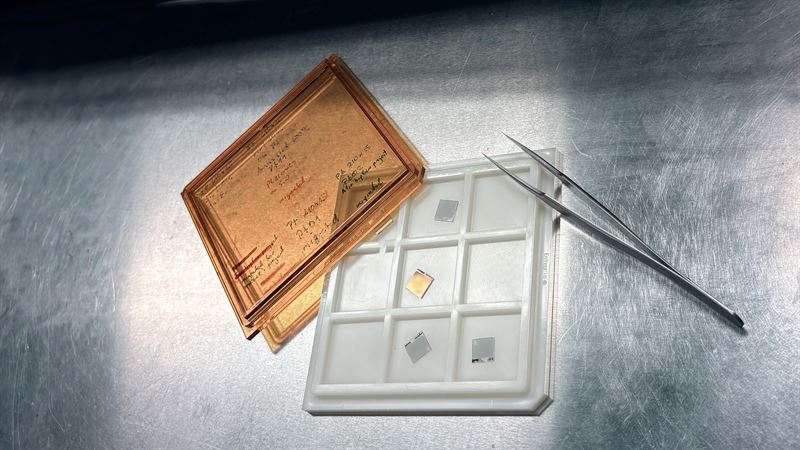
Hydrogen plays an important role in society’s energy transition. For the technology to be used on a broad scale, effective hydrogen sensors are required to prevent the formation of flammable oxyhydrogen gas when hydrogen is mixed with air. Now, researchers at Chalmers University of Technology, Sweden, can present a compact sensor that can be manufactured on a large scale and is well suited to the humid environments where hydrogen is to be found. Unlike today’s sensors, the new sensor performs better the more humid it gets.
Image: Chalmers University of Technology | Mia Halleröd Palmgren
Wherever hydrogen is present, safety sensors are required to detect leaks and prevent the formation of flammable oxyhydrogen gas when hydrogen is mixed with air. It is therefore a challenge that today’s sensors do not work optimally in humid environments – because where there is hydrogen, there is very often humidity. Now, researchers at Chalmers University of Technology, Sweden, are presenting a new sensor that is well suited to humid environments – and actually performs better the more humid it gets.
“The performance of a hydrogen gas sensor can vary dramatically from environment to environment, and humidity is an important factor. An issue today is that many sensors become slower or perform less effectively in humid environments. When we tested our new sensor concept, we discovered that the more we increased the humidity, the stronger the response to hydrogen became. It took us a while to really understand how this could be possible,“ says Chalmers doctoral student Athanasios Theodoridis, who is the lead author of the article in the journal ACS Sensors.
Hydrogen is an increasingly important energy carrier in the transport sector and is used as a raw material in the chemical industry or for green steel manufacturing. In addition to water being constantly present in ambient air, it is also formed when hydrogen reacts with oxygen to generate energy, for example in a fuel cell that can be used in hydrogen-powered vehicles and ships. Furthermore, fuel cells themselves require water to prevent the membranes that separate oxygen and hydrogen inside them from drying out.
Facilities where hydrogen is produced and stored are also constantly in contact with the surrounding air, where humidity varies greatly over time depending on temperature and weather conditions. Therefore, to ensure that the volatile hydrogen gas does not leak and create flammable oxyhydrogen, reliable humidity-tolerant sensors are needed here as well.
The sensor causes the humidity to ‘boil away’
The new humidity-tolerant hydrogen sensor from Chalmers fits on a fingertip and contains tiny particles – nanoparticles – of the metal platinum. The particles act as both catalysts and sensors at the same time. This means that the platinum accelerates the chemical reaction between hydrogen and oxygen from the air, which leads to heat development that causes the humidity, in the form of a film of water on the sensor surface, to ‘boil away’. The amount of hydrogen in the air determines how much of the water film boils away, and the moisture content in the air controls the thickness of the film. It is therefore possible to measure the concentration of hydrogen by measuring the thickness of the water film. And since the thickness of the water film increases as the air becomes more humid, the sensor’s efficiency increases at the same rate. The result of this process can be observed using an optical phenomenon called plasmons, where the platinum nanoparticles capture light and give them a distinct colour. When the concentration of hydrogen gas in the environment changes, the nanoparticles change colour, and at critical levels the sensor triggers an alarm.
At Chalmers, the development of plasmonic hydrogen gas sensors has been under way for many years. Professor Christoph Langhammer’s research team has made several major breakthroughs in the field in terms of sensor speed and sensitivity, as well as the ability to optimise sensor response and humidity resistance using AI. Previously, the group based its sensors on nanoparticles of the metal palladium, which absorbs hydrogen in much the same way as a sponge absorbs water. The new platinum-based concept, developed within the framework of the TechForH2 competence centre at Chalmers, has led to the creation of a new type of sensor – a “catalytic plasmonic hydrogen gas sensor” – which opens up new possibilities.
“We tested the sensor for over 140 hours of continuous exposure to humid air. The tests showed that it is stable at various given degrees of humidity and can reliably detect hydrogen gas in these conditions, which is important if it is to be used in real-world environments,” says Athanasios Theodoridis.
The energy transition is placing greater demands on sensors
According to the researchers’ measurements, the sensor detects hydrogen down to the ‘parts per million’ range: 30 ppm – that is, three thousandths of a per cent, making it one of the world’s most sensitive hydrogen gas sensors in humid environments.
“There is currently strong demand for sensors that perform well in humid environments. As hydrogen plays an increasingly important role in society, there are growing demands for sensors that are not only smaller and more flexible, but also capable of being manufactured on a large scale and at a lower cost. Our new sensor concept satisfies these requirements well,” says Christoph Langhammer, Professor of Physics at Chalmers and one of the founders of the sensor company Insplorion, where he now serves in an advisory capacity.
He also recognises that more than one type of material may be required for future hydrogen gas sensors to function in all types of environments.
“We expect to need to combine different types of active materials to create sensors that perform well regardless of the environment. We now know that certain materials provide speed and sensitivity, while others are better able to withstand humidity. We are now working to apply this knowledge going forward,” says Christoph Langhammer.
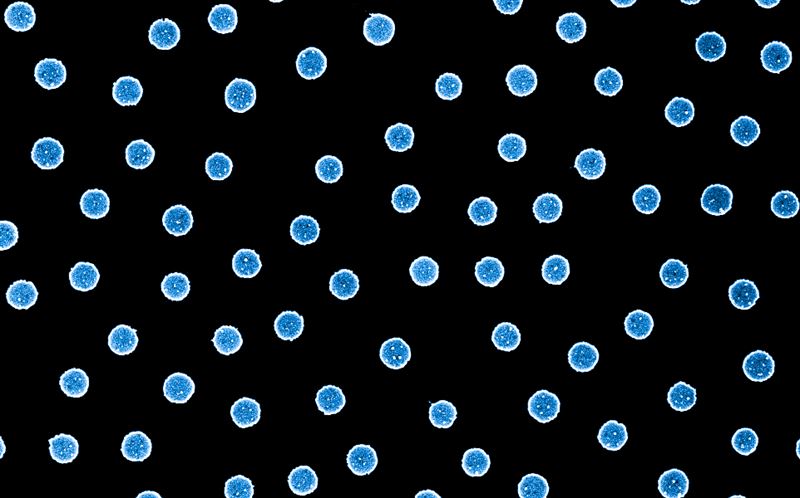
The new hydrogen sensor from Chalmers University of Technology, Sweden, is based on tiny particles of the metal platinum. The particles act as both catalysts and sensors at the same time, and the sensor is well suited to humid environments. It actually performs better the more humid it gets. (The platinum particles in this microscope image have been coloured.)
Image: Chalmers University of Technology | Athanasios Theodoridis
More about the research:
The article A Catalytic-Plasmonic Pt Nanoparticle Sensor for Hydrogen Detection in High-Humidity Environments has been published in ACS Sensors. It was written by Athanasios Theodoridis, Carl Andersson, Sara Nilsson, Joachim Fritzsche and Christoph Langhammer. All researchers are or were employed in the Department of Physics at Chalmers University of Technology when the research was conducted.
The sensor was developed in Chalmers’ clean room (the Myfab nanofabrication laboratory) and Chalmers’ materials analysis laboratory (CMAL), under the umbrella of Chalmers’ Area of Advance Nano.
The research has been funded by the Swedish Foundation for Strategic Research, the Knut and Alice Wallenberg Foundation, Vinnova and the TechForH2 competence centre, hosted by Chalmers University of Technology. TechForH2 is supported by the Swedish Energy Agency, Volvo, Scania, Siemens Energy, GKN Aerospace, PowerCell, Oxeon, RISE, Stena Rederier AB, Johnsson Matthey and Insplorion.
Christoph Langhammer is one of the founders of Insplorion, a company that was started fifteen years ago via the Chalmers School of Entrepreneurship. Last year, the company launched its first hydrogen gas sensor based on nanoplasmonic technology.
For more information, please contact:
Athanasios Theodoridis, doctoral student, Department of Physics, Chalmers University of Technology, Sweden, athanasios.theodoridis@chalmers.se
Christoph Langhammer, professor, Department of Physics, Chalmers University of Technology, Sweden, +46 31 772 33 31, clangham@chalmers.se
Christoph Langhammer speaks English, Swedish and German; Athanasios Theodoridis speaks English and Greek. At Chalmers, we have podcast studios and film equipment on site and can assist with requests for television, radio or podcast interviews.
Read previous press releases about hydrogen sensors developed by Chalmers:
Ultra-sensitive optical sensor can reduce hydrogen’s risks
World’s fastest hydrogen sensor could pave the way for clean energy
Read more press releases from Chalmers about hydrogen:
Solar hydrogen can now be produced efficiently without the scarce metal platinum
The best hydrogen for heavy-duty transport is locally produced and green
Mia Halleröd Palmgren
Press Officer
+46 31 772 32 52
mia.hallerodpalmgren@chalmers.se
________________
Chalmers University of Technology in Gothenburg, Sweden, conducts research and education in technology and natural sciences at a high international level. The university has 3100 employees and 10,000 students, and offers education in engineering, science, shipping and architecture.
With scientific excellence as a basis, Chalmers promotes knowledge and technical solutions for a sustainable world. Through global commitment and entrepreneurship, we foster an innovative spirit, in close collaboration with wider society.
Chalmers was founded in 1829 and has the same motto today as it did then: Avancez – forward.
---
Images provided in Chalmers University of Technology press releases are, unless specified otherwise, free for download and publication as long as credit is given to the University and the individual creator. Cropping and rescaling of the images is permitted when required for adaptation to the publication’s format, but modifications that would influence the message and content of the original are not. The material is primarily intended for journalistic and informative use, to assist in communication and coverage of Chalmers’ research and education. Commercial usage, for example the marketing of goods and services, is not permitted.
We kindly request credit to be given in the following format where possible:
Image/Graphic/Illustration: Chalmers University of Technology | Name Surname