
Magnetism in new exotic material opens the way for robust quantum computers
The entry of quantum computers into society is currently hindered by their sensitivity to disturbances in the environment. Researchers from Chalmers University of Technology in Sweden, and Aalto University and the University of Helsinki in Finland, now present a new type of exotic quantum material, and a method that uses magnetism to create stability. This breakthrough can make quantum computers significantly more resilient – paving the way for them to be robust enough to tackle quantum calculations in practice.
At the atomic scale, the laws of physics deviate from those in our ordinary large-scale world. There, particles adhere to the laws of quantum physics, which means they can exist in multiple states simultaneously and influence each other in ways that are not possible within classical physics. These peculiar but powerful phenomena hold the key to quantum computing and quantum computers, which have the potential to solve problems that no conventional supercomputer can handle today.
But before quantum calculations can benefit society in practice, physicists need to solve a major challenge. Qubits, the basic units of a quantum computer, are extremely delicate. The slightest change in temperature, magnetic field, or even microscopic vibrations causes the qubits to lose their quantum states – and therefore also their ability to perform complex calculations reliably.
To solve the problem, researchers in recent years have begun exploring the possibility of creating materials that can provide better protection against these types of disturbances and noise in their fundamental structure – their topology. Quantum states that arise and are maintained through the structure of the material used in qubits are called topological excitations and are significantly more stable and resilient than others. However, the challenge remains to find materials that naturally support such robust quantum states.
Newly developed material protects against disturbances
Now, a research team from Chalmers University of Technology, Aalto University, and the University of Helsinki has developed a new quantum material for qubits that exhibits robust topological excitations. The breakthrough is an important step towards realising practical topological quantum computing by constructing stability directly into the material's design.
“This is a completely new type of exotic quantum material that can maintain its quantum properties when exposed to external disturbances. It can contribute to the development of quantum computers robust enough to tackle quantum calculations in practice”, says Guangze Chen, postdoctoral researcher in applied quantum physics at Chalmers and lead author of the study published in Physical Review Letters.
‘Exotic quantum materials’ is an umbrella term for several novel classes of solids with extreme quantum properties. The search for such materials, with special resilient properties, has been a long-standing challenge.
Magnetism is the key in the new strategy
Traditionally, researchers have followed a well-established ‘recipe’ based on spin-orbit coupling, a quantum interaction that links the electron's spin to its movement orbit around the atomic nucleus to create topological excitations. However, this ‘ingredient’ is relatively rare, and the method can therefore only be used on a limited number of materials.
In the study, the research team presents a completely new method that uses magnetism – a much more common and accessible ingredient – to achieve the same effect. By harnessing magnetic interactions, the researchers were able to engineer the robust topological excitations required for topological quantum computing.
“The advantage of our method is that magnetism exists naturally in many materials. You can compare it to baking with everyday ingredients rather than using rare spices”, explains Guangze Chen. “This means that we can now search for topological properties in a much broader spectrum of materials, including those that have previously been overlooked.”
Paving the way for next-generation quantum computer platforms
To accelerate the discovery of new materials with useful topological properties, the research team has also developed a new computational tool. The tool can directly calculate how strongly a material exhibits topological behaviour.
“Our hope is that this approach can help guide the discovery of many more exotic materials”, says Guangze Chen. “Ultimately, this can lead to next-generation quantum computer platforms, built on materials that are naturally resistant to the kind of disturbances that plague current systems.”
More about the study:
The scientific paper Topological Zero Modes and Correlation Pumping in an Engineered Kondo Lattice has been published in Physical Review Letters. The study was conducted by Zina Lippo at University of Helsinki, Elizabeth Louis Pereira and Jose L. Lado at Aalto University, and Guangze Chen at Chalmers University of Technology.
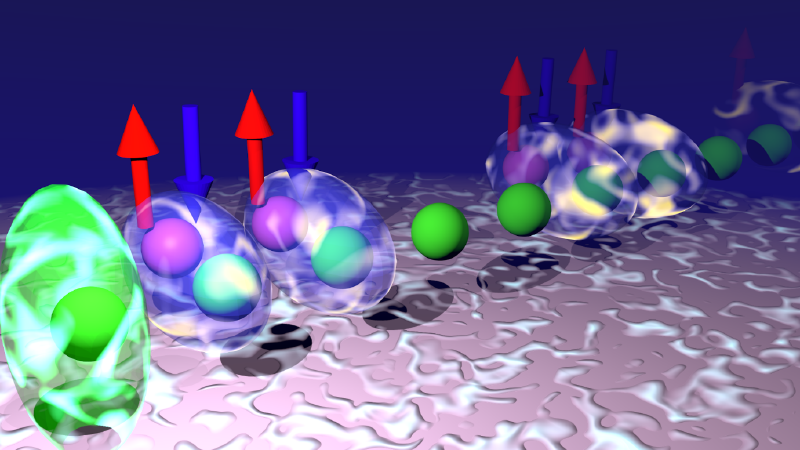
Top image caption; Magnetism plays the key role in a new quantum strategy
Illustration of a new strategy to create materials with robust quantum properties, by harnessing magnetic interactions (represented by the red and blue arrows). The small green spheres represent sites where electrons can reside and move along the chain. Special magnetic atoms (purple spheres with arrows) interact with the electrons at certain sites, shown by the blueish clouds. These interactions create protected edge states (green cloud) that could help make quantum computers more stable and less sensitive to noise.
Illustration: Jose L. Lado
For more information, please contact:
Guangze Chen, postdoctoral researcher, Applied Quantum Physics, Department of Microtechnology and Nanoscience, Chalmers University of Technology, Sweden, +46 72 447 4457, guangze@chalmers.se
Guangze Chen speaks English and Chinese. At Chalmers, we have podcast studios and film equipment on site and can assist with requests for TV, radio or podcast interviews.
Johanna Wilde
Press officer
+46-31-772 2029
johanna.wilde@chalmers.se
________________
Chalmers University of Technology in Gothenburg, Sweden, conducts research and education in technology and natural sciences at a high international level. The university has 3100 employees and 10,000 students, and offers education in engineering, science, shipping and architecture.
With scientific excellence as a basis, Chalmers promotes knowledge and technical solutions for a sustainable world. Through global commitment and entrepreneurship, we foster an innovative spirit, in close collaboration with wider society.
Chalmers was founded in 1829 and has the same motto today as it did then: Avancez – forward.
---
Images provided in Chalmers University of Technology press releases are, unless specified otherwise, free for download and publication as long as credit is given to the University and the individual creator. Cropping and rescaling of the images is permitted when required for adaptation to the publication’s format, but modifications that would influence the message and content of the original are not. The material is primarily intended for journalistic and informative use, to assist in communication and coverage of Chalmers’ research and education. Commercial usage, for example the marketing of goods and services, is not permitted.
We kindly request credit to be given in the following format where possible:
Image/Graphic/Illustration: Chalmers University of Technology | Name Surname
Tags: