
Minimal pixels achieve the highest possible resolution visible to the human eye
In an article in the science journal Nature, researchers from Chalmers University of Technology, the University of Gothenburg and Uppsala University, Sweden, present a technology with the smallest pixels ever, in a screen with the highest resolution possible for the human eye to perceive. The pixels reproduce colours using nanoparticles whose dimensions and arrangement control how light is scattered, and whose optical properties can be electrically tuned. This breakthrough paves the way for the creation of virtual worlds that are visually indistinguishable from reality.
As the transfer of information in our society becomes more complex, so the demand increases for screens that transmit images and video with precision.
‘The technology that we have developed can provide new ways to interact with information and the world around us. It could expand creative possibilities, improve remote collaboration, and even accelerate scientific research,’ says Kunli Xiong, Associate Senior Lecturer/Assistant Professor at the Department of Materials Science and Engineering at Uppsala University, who conceived the project and is the lead author of the study.
It is the size and number of pixels that determine the resolution, and thereby how realistic images and films displayed on screens can be. In virtual or augmented reality, where the screen is small and close to the eye, the experience is limited by the fact that today’s pixels cannot be made small enough. On a micro-LED screen, for example, pixels work poorly when they become smaller than one micrometre in size. However, in the article Video‐rate tunable colour electronic paper with human resolution published in the scientific journal Nature, researchers present retina E-paper, a new type of electronic paper, or reflective screen. Each pixel is approximately 560 nanometres and the overall screen area is comparable to the size of the human pupil, with a resolution of beyond 25,000 ppi (pixles per inch).
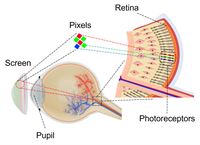
‘This means that each pixel roughly corresponds to a single photoreceptor in the eye, i.e. the nerve cells in the retina that convert light into biological signals. Humans cannot perceive a higher resolution than this,’ says Andreas Dahlin, Professor at the Department of Chemistry and Chemical Engineering at Chalmers.
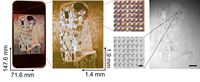
The retina E-paper can be placed very close to the eye. To demonstrate the technology's performance, researchers recreated an image of Gustav Klimt’s famous artwork ‘The Kiss’ on a surface area of approximately 1.4 × 1.9 millimetres. By way of comparison, this means that the image was 1/4000th that of a standard smartphone.
As in previous research led by Andreas Dahlin, the screen is passive, meaning that it does not contain its own light source; instead, the colours of the pixels appear when ambient light hits small structures on a surface. The same principle can be found in the magnificent plumage of small birds. The ultrasmall pixels contain particles of tungsten oxide. By adjusting the size of the particles and how they are positioned in relation to one another, the researchers have succeeded in controlling how the colours in light are diffused and reflected, thereby creating pixels in the colours red, green and blue, which can then be used to generate all colours. By applying a weak voltage, the particles can be ‘switched off’ and they will turn black.
‘This is a major step forward in the development of screens that can be shrunk to miniature size while improving quality and reducing energy consumption. The technology needs to be fine-tuned further, but we believe that retina E-paper will play a major role in its field and will eventually have impact on us all,’ says Giovanni Volpe, Professor at the Department of Physics at the University of Gothenburg.
Captions:
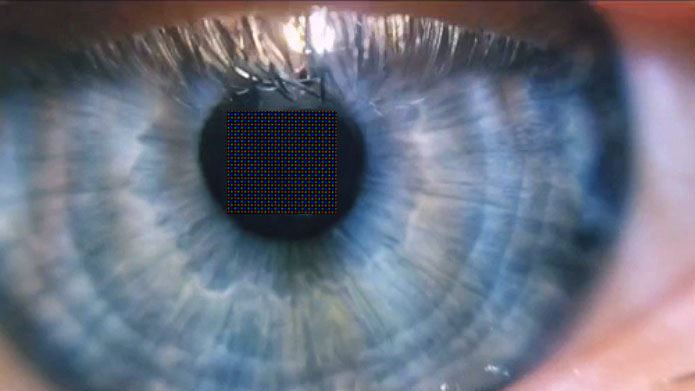
1. The retina E-paper is a new type of electronic paper, or reflective screen, with submicrometre pixels and a resolution of beyond 25, 000 ppi (pixles per inch). Each pixel roughly corresponds to a single photoreceptor in the eye, which means that humans cannot perceive a higher resolution. The photo collage is an illustration of the concept. Collage by Chalmers | Mia Halleröd Palmgren. Images by: (eye) Petrovalera16, (pixles | Artemlys, CC BY-SA 4.0 , via Wikimedia Commons.
2. Illustration of a pupil-sized display inspired by the human retina, packed with ultrahigh-resolution submicrometre pixels. Credit: Nature
3. Side-by-side comparison of Gustav Klimt’s “The Kiss” on retina E-paper and a smartphone. The retina E-paper is roughly 1/4000 the size of the smartphone screen, yet its colours are produced by precisely arranged cyan, magenta, and yellow subpixels. Credit: Nature
For more information, please contact:
Andreas Dahlin, Professor at the Department of Chemistry and Chemical Engineering, Chalmers University of Technology, Sweden: +46 70-763 27 79, adahlin@chalmers.se
Kunli Xiong, Associate Senior Lecturer/Assistant Professor at the Department of Materials Science and Engineering, Uppsala University, Sweden: +46 73-469 72 24, kunli.xiong@angstrom.uu.se
Giovanni Volpe, Professor at the Department of Physics at the University of Gothenburg, Sweden +46 76-622 91 37, giovanni.volpe@physics.gu.se
More about the research:
Video‐rate tunable colour electronic paper with human resolution has been published in Nature.
The authors of the study are Ade Satria Saloka Santosa, Yu-Wei Chang, Andreas B. Dahlin, Lars Österlund, Giovanni Volpe and Kunli Xiong.
At the time the study was conducted, the researchers were active at Chalmers University of Technology, the University of Gothenburg and the Ångström Laboratory at Uppsala University, Sweden.
Karin Wik
Press officer
+46-078 864835
karin.wik@chalmers.se
________________
Chalmers University of Technology in Gothenburg, Sweden, conducts research and education in technology and natural sciences at a high international level. The university has 3100 employees and 10,000 students, and offers education in engineering, science, shipping and architecture.
With scientific excellence as a basis, Chalmers promotes knowledge and technical solutions for a sustainable world. Through global commitment and entrepreneurship, we foster an innovative spirit, in close collaboration with wider society.
Chalmers was founded in 1829 and has the same motto today as it did then: Avancez – forward.
---
Images provided in Chalmers University of Technology press releases are, unless specified otherwise, free for download and publication as long as credit is given to the University and the individual creator. Cropping and rescaling of the images is permitted when required for adaptation to the publication’s format, but modifications that would influence the message and content of the original are not. The material is primarily intended for journalistic and informative use, to assist in communication and coverage of Chalmers’ research and education. Commercial usage, for example the marketing of goods and services, is not permitted.
We kindly request credit to be given in the following format where possible:
Image/Graphic/Illustration: Chalmers University of Technology | Name Surname