
Nobel Prize-awarded material that puncture and kill bacteria
Bacteria that multiply on surfaces are a major headache in healthcare when they gain a foothold on, for example, implants or in catheters. Researchers at Chalmers University of Technology in Sweden have found a new weapon to fight these hotbeds of bacterial growth – one that does not rely on antibiotics or toxic metals. The key lies in a completely new application of this year's Nobel Prize-winning material: metal-organic frameworks. These materials can physically impale, puncture and kill bacteria before they have time to attach to the surface.
Because once bacteria attach to a surface, they start to multiply while encasing themselves in what is known as a biofilm – a viscous, slimy coating that protects the bacteria and makes them difficult to kill. Biofilms thrive particularly well in humid environments and can pose serious challenges in healthcare. For example, bacteria can attach to medical devices such as catheters, hip replacements and dental implants, and lead to hospital-acquired infections (HAI), also known as nosocomial infections – a widespread problem worldwide that causes great suffering and high healthcare costs, and an increased risk of the development of antibiotic resistance.
Biofilms can also form on ship hulls, where they can lead to troublesome algal biofouling and barnacle growth, slowing down the ship while increasing its fuel consumption. Furthermore, antifouling paints containing toxic biocides are often used on ship hulls to combat this problem, with an associated risk of harmful substances leaching into the marine environment. Biofilms in industrial piping systems are also a widespread problem that can cause corrosion, clog the systems, reduce their efficiency, and increase energy consumption for example.
New way to use metal-organic frameworks
Researchers at Chalmers University of Technology have now found a new way to attack biofilms by coating surfaces with nanostructures – metal-organic frameworks – that kill bacteria mechanically. The recently published study was carried out in a collaboration between two teams of researchers at the University: Professor Ivan Mijakovic’s and Professor Lars Öhrström’s.
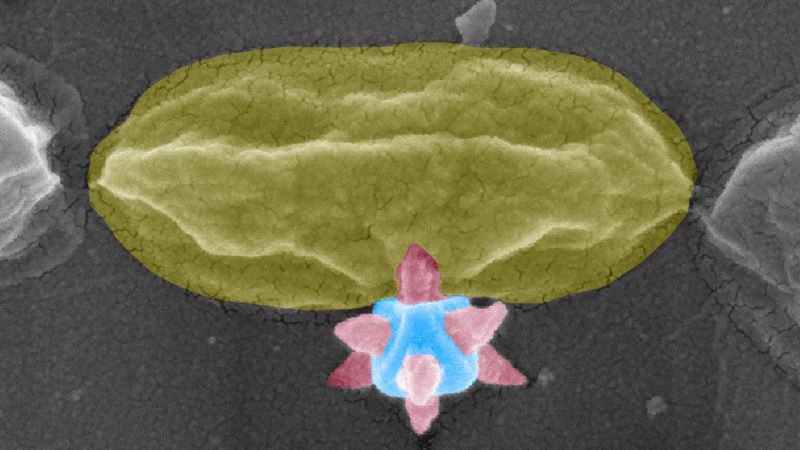
“Our study shows that these nanostructures can act like tiny spikes that physically injure the bacteria, quite simply puncturing them so that they die. It’s a completely new way of using such metal-organic frameworks,” says the study’s lead author Zhejian Cao, PhD in Materials Engineering and researcher at Chalmers.
The coating is constructed in a way that allows it to be applied to a variety of surfaces and integrated into other materials. A major advantage of the method is that it prevents or reduces biofilm formation without the need to use antibiotics or toxic metals.
“It fights a major global problem, as it eliminates the risk that controlling bacteria will lead to antibiotic resistance,” says Zhejian Cao.
A challenge to find the right distance between the nanotips
Metal-organic frameworks (MOFs) are a new class of materials with exceptional properties where metal ions are interlinked into three-dimensional structures with large cavities and channels in the material. The researchers behind the development of this class of materials were awarded the 2025 Nobel Prize in Chemistry, and the hope is that these materials can be used for everything from biogas storage and carbon capture to catalysis and water extraction from desert air.
The Chalmers researchers explored a completely different function for MOFs in their study.
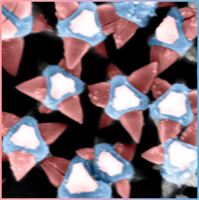
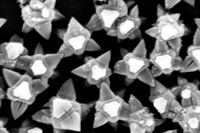
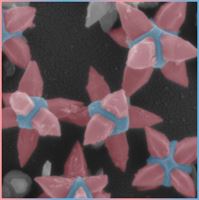
“There have been previous attempts to use metal-organic frameworks for antibacterial purposes, but in those cases the bacteria were killed by toxic metal ions or antimicrobial agents released by the MOFs. Instead, we have grown one MOF on top of another, which results in the formation of sharp nanotips that can puncture and kill the bacteria when they approach,” says Zhejian Cao.
The nanotips were created by controlling the crystalline growth in the material, and a major challenge was finding the right distance between the nanotips to maximize their effect.
“If the distance between the nanotips is too large, bacteria can slip through and attach to the surface. If the distance is too small, however, the mechanical stress exerted by the nanotips on the bacterial cell capsule may be reduced so that the bacteria survive – the same principle that allows you to lie on a bed of nails without getting hurt,” says Zhejian Cao.
Possible to achieve large-scale production
Lars Öhrström is a co-author of the study and has worked with metal-organic frameworks for 30 years. He emphasises that there are numerous practical advantages to using MOF coatings for controlling bacteria on surfaces compared to other solutions.
“These coatings can be produced at much lower temperatures than, for example, the graphene arrays previously developed at Chalmers. This facilitates large-scale production and makes it possible to apply the coatings to temperature-sensitive materials such as the plastics used in medical implants. In addition, the organic polymers in metal-organic frameworks can be created from recycled plastics, having the potential to contribute to a circular economy,” says Lars Öhrström.
More about the research
The article Mechano-Bactericidal Surfaces Achieved by Epitaxial Growth of Metal-Organic Frameworks has been published in the scientific journal Advanced Science. The authors are Zhejian Cao, Santosh Pandit, Françoise M. Amombo Noa, Jian Zhang, Wengeng Gao, Shadi Rahimi, Lars Öhrström and Ivan Mijakovic, all of whom are active at Chalmers University of Technology, Sweden.
The study was conducted in Professor Lars Öhrström’s research group at the Department of Chemistry and Chemical Engineering, and in Professor Ivan Mijakovic’s group at the Department of Life Sciences.
The research was funded by the Knut and Alice Wallenberg Foundation as part of the Wallenberg Initiative Materials Science for Sustainability (WISE), and by NordForsk, the Novo Nordisk Foundation, the Independent Research Fund Denmark, the Swedish Research Council, and Chalmers’ Nano, Materials, and Health Areas of Advance.
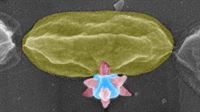
Banner image: A scanning electron microscopy image of the MOF-on-MOF surface with sharp nanotips killing the bacteria. The image was taken in Myfab's cleanroom at Chalmers University of Technology. Parts of the image have been colored.
Credit: Chalmers University of Technology | Zhejian Cao
For more information, please contact:
Zhejian Cao, postdoctoral research fellow at the Department of Life Sciences, Chalmers University of Technology, Sweden, zhejian@chalmers.se
Zhejian Cao speaks English and Chinese.
Lars Öhrström, Professor at the Department of Chemistry and Chemical Engineering, Chalmers University of Technology, Sweden, ohrstrom@chalmers.se, +46 31 772 28 71
Lars Öhrström speaks Swedish, French and English.
Henrik Dahlberg
Head of Media Relations
+46 31 772 19 40
henrik.dahlberg@chalmers.se
________________
Chalmers University of Technology in Gothenburg, Sweden, conducts research and education in technology and natural sciences at a high international level. The university has 3100 employees and 10,000 students, and offers education in engineering, science, shipping and architecture.
With scientific excellence as a basis, Chalmers promotes knowledge and technical solutions for a sustainable world. Through global commitment and entrepreneurship, we foster an innovative spirit, in close collaboration with wider society.
Chalmers was founded in 1829 and has the same motto today as it did then: Avancez – forward.
---
Images provided in Chalmers University of Technology press releases are, unless specified otherwise, free for download and publication as long as credit is given to the University and the individual creator. Cropping and rescaling of the images is permitted when required for adaptation to the publication’s format, but modifications that would influence the message and content of the original are not. The material is primarily intended for journalistic and informative use, to assist in communication and coverage of Chalmers’ research and education. Commercial usage, for example the marketing of goods and services, is not permitted.
We kindly request credit to be given in the following format where possible:
Image/Graphic/Illustration: Chalmers University of Technology | Name Surname