
Physics-trained digital ‘super-brain’ speeds up technology development
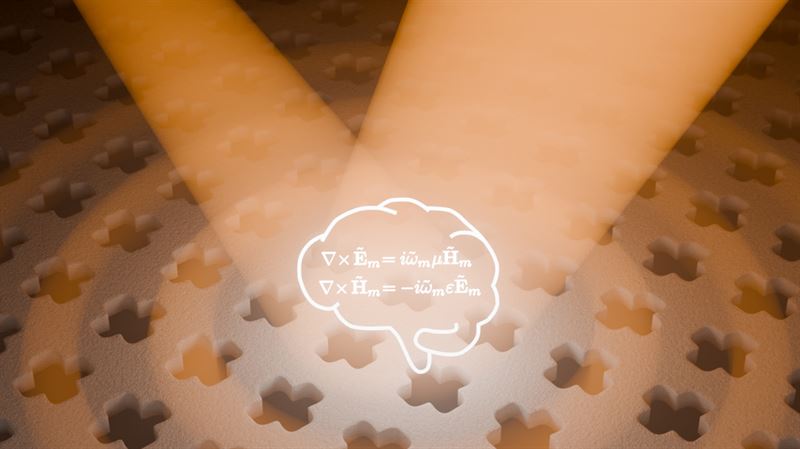
Illustration: Chalmers University of Technology | Viktor Lilja
Studying physics can be very useful – even when it comes to machine learning. A digital ‘super-brain’ with built-in knowledge of the fundamental laws of nature can speed up the development of optical components for everything from quantum computers to eyeglass or camera lenses according to a new study from Chalmers University of Technology in Sweden.
“When we fed the super-brain information about the laws of physics, it immediately got much smarter. Our calculations now take one tenth of the time previously required,” says Philippe Tassin, professor at the Department of Physics and Astronomy, Chalmers University of Technology.
The research team led by Philippe Tassin designs optical components in a field called nanophotonics. On a small scale – less than one wavelength – light can be controlled and manipulated in a completely different way than on larger scales. But there are also limitations on how light can be controlled in advanced ways in natural optical materials. To get around these limitations, the research team is investigating and designing artificial optical materials using computer simulations.
These materials can be used in camera or eyeglass lenses to make them lighter, thinner and more effective. But the group’s research may also have a bearing on the future of quantum computing. Together with researchers at the Department of Microtechnology and Nanoscience at Chalmers, where Sweden’s first larger quantum computer is being built, they are investigating whether it is possible to design nanostructured materials that can control how light travels. The idea is that information sent between quantum computers, or over a longer distance, could be transmitted using optical frequencies via mechanically compliant photonics crystals – small man-made crystals that have an extremely high capacity to reflect light.
Simulations show how to design the material optimally
The research group’s work is done entirely with simulations in supercomputers, where machine learning and neural networks – a kind of artificial intelligence inspired by the structure of the human brain – are their right hand. The simulations show and draw conclusions about the properties of the material and are crucial for the researchers when working out how to design the material optimally.
“I know electromagnetism’s equations inside out and I teach them, but I still can’t draw all the conclusions that the neural network can. The physics is so complex that I don’t understand the properties of a material just by looking at it – but the computer does,” says Philippe Tassin.
Time-consuming to feed data into neural networks
However, feeding data into a neural network so it can perform the simulations is very time-consuming. Generating a single data point can take between ten minutes and an hour, and up to 40,000 simulations may be required.
“It might take us a whole month to generate enough data to train the neural network. Then if you realise that you need to add more things, it can take another month,” says Viktor Lilja, doctoral student at the Department of Physics and Astronomy, Chalmers University of Technology.
But now the researchers have come up with a way to do the job in one tenth of the time they previously spent. What previously took thirty days to generate now takes three days. All because they have given the neural network a basic understanding of physics – even before it has been trained.
Teaching the neural network the laws of physics
The underlying idea is that an optical component must obey the laws of physics and electromagnetism. What the researchers have done is teach the neural network these laws – giving it a kind of basic education in physics. Previously, the neural network needed to learn these laws by drawing its own conclusions from the data generated. Now this super-brain can use its own knowledge instead of ‘reinventing the wheel’ every time.
The idea came up when the researchers were trying to make the neural network’s predictions easier to interpret by building in equations that we humans recognise. Then when they tested the network, it turned out that it had also automatically become much smarter, so it needed less data to be trained effectively. The researchers described how they went about this in an article published in the scientific journal Laser & Photonics Reviews.
“Once we’d trained the network, we could ask it to examine any structure at all and get the optical properties in a millisecond. With these new networks, we get better estimates and avoid obvious errors,” says Viktor Lilja.
Philippe Tassin thinks that the time saved is the biggest benefit.
“Now that we can work so much faster, we can speed up design development for optical components.”
More about the research:
The research is presented in the article A General Framework for Knowledge Integration in Machine Learning for Electromagnetic Scattering Using Quasinormal Modes, Laser & Photonics Reviews. The authors are Viktor Lilja, Albin Svärdsby, Timo Gahlmann and Philippe Tassin of the Department of Physics and Astronomy at Chalmers University of Technology, Sweden.
The research was funded by the Chalmers Nano Area of Advance, the Swedish Research Council, and the Knut and Alice Wallenberg Foundation. The training of the neural network was carried out using resources provided by the Swedish National Infrastructure for Computing (NAISS) at Chalmers/C3SE and KTH/PDC, in part with funding from the Swedish Research Council. The work was carried out in part within the META-PIX competence centre at Chalmers.
For more information, please contact:
Philippe Tassin, Professor, Department of Physics and Astronomy, Chalmers University of Technology, Sweden, philippe.tassin@chalmers.se, +46 31 772 22 92
Viktor Lilja, Doctoral student, Department of Physics and Astronomy, Chalmers University of Technology, Sweden, viktor.lilja@chalmers.se
Philippe Tassin speaks Swedish, English and Dutch. Viktor Lilja speaks Swedish and English. At Chalmers, we have podcast studios and filming equipment on-site and can assist with requests for TV, radio, or podcast interviews.
Mia Halleröd Palmgren
Press Officer
+46 31 772 32 52
mia.hallerodpalmgren@chalmers.se
________________
Chalmers University of Technology in Gothenburg, Sweden, conducts research and education in technology and natural sciences at a high international level. The university has 3100 employees and 10,000 students, and offers education in engineering, science, maritime studies and architecture.
With scientific excellence as a basis, Chalmers promotes knowledge and technical solutions for a sustainable world. Through global commitment and entrepreneurship, we foster an innovative spirit, in close collaboration with wider society.
Chalmers was founded in 1829 and has the same motto today as it did then: Avancez – forward.
---
Images provided in Chalmers University of Technology press releases are, unless specified otherwise, free for download and publication as long as credit is given to the University and the individual creator. Cropping and rescaling of the images is permitted when required for adaptation to the publication’s format, but modifications that would influence the message and content of the original are not. The material is primarily intended for journalistic and informative use, to assist in communication and coverage of Chalmers’ research and education. Commercial usage, for example the marketing of goods and services, is not permitted.
We kindly request credit to be given in the following format where possible:
Image/Graphic/Illustration: Chalmers University of Technology | Name Surname