
Pioneering recipe for conductive plastics – paves the way for your body to go online
It’s mouldable, biocompatible and glitters like gold. Plastic that can conduct an electric charge is a material that can be used for everything from sensors that can monitor our health to self-cooling clothing or electronic adhesive plasters that can be applied to the skin and send data directly to a mobile phone. Researchers at Chalmers University of Technology in Sweden recently presented a ground-breaking ‘recipe’ that makes it easier to manufacture this kind of sought-after electrically conductive plastic in larger quantities – without the use of harmful chemicals, and in a much more cost-effective way.
“Once higher production volumes are achieved, it is possible to work with the material in a completely different way. Larger quantities are needed to enable the development of a range of applications, for example in biotechnology, energy storage, and wearable electronics,” says Christian Müller, Professor at the Department of Chemistry and Chemical Engineering at Chalmers and co-author of a study recently published in Science Advances.
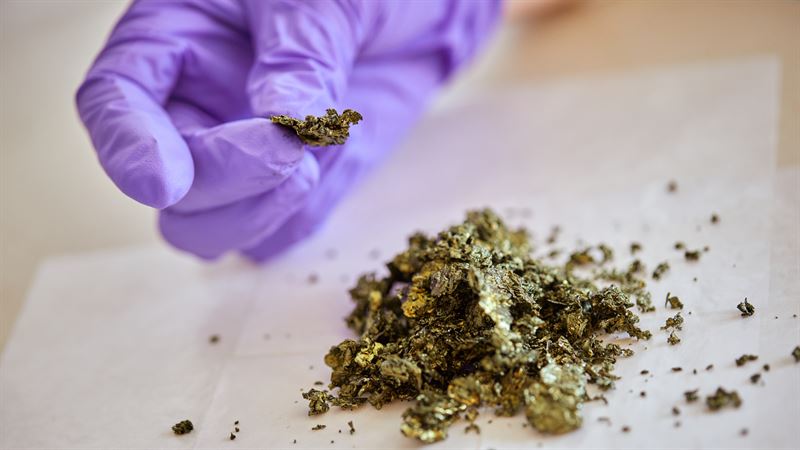
In the lab in the Chemistry building at Chalmers, doctoral student Joost Kimpel shows how this glittering, gold-coloured material can be easily moulded with his gloved fingers. Currently, the market price for just 100 grams of this type of conductive plastic would be around USD 100,000 – about ten times as much as actual gold. But for the human body, it is in fact the absence of metals that makes this material so valuable.
“While some metals can corrode in humid environments, conductive plastic is an organic material that our bodies are comfortable with. The material is compatible with the body’s own tissue, while also being a semiconductor. There’s also an environmental advantage in that you don’t need to use the rare earth elements required for today’s electronics,” says Joost Kimpel, first author of the new study.
Electronic adhesive plasters with connectivity
There is great interest in conductive plastics, or conjugated polymers which is the scientific term for them, and the applications are many – not least in biotechnology. According to the researchers, these applications could include sensors that monitor medical conditions, provide information about fitness and health, or adjust the delivery of drugs for diseases that are difficult to treat. With this kind of technology, the body can be connected to other wearable electronics, and even to our mobile phones.
Conductive plastics can also be used for various kinds of implants or be 3D-printed to create electronic adhesive plasters that can detect an infection, for example.
Research into conductive plastics is being carried out in many parts of the world. Christian Müller’s research group has been exploring this type of material for more than a decade, and has made several important advances in the field.
Unexpected lab results behind the latest advance
The key to the new manufacturing method was discovered quite serendipitously – during a routine experiment in the lab. When a chemical reaction was happening too fast and the resulting plastic was reaching its final state too quickly, the idea came up of reducing the heat in the process. This was what led to the discovery that you can produce this material at room temperature – involving significantly fewer steps, with lower energy consumption, and without toxic chemicals.
“The ingredients in our ‘recipe’ are benign and can be used safely in an industrial setting, unlike the highly toxic substances that must be used to produce many conjugated polymers today. Avoiding toxic chemicals in the production process means a safer work environment for staff, gives the consumer peace of mind, and facilitates recycling. In addition, the costs can be radically reduced, as toxic substances require advanced handling, especially in terms of protective procedures, storage and the disposal of residues,” says Joost Kimpel.
Great interest in the new method
Even though the study was published very recently, the researchers have already noted a great deal of interest, not least from the many researchers at other universities who have contacted them. Now they hope that this new production method will facilitate making conductive plastics more widely available.
“An important discovery made in this study is that the production method makes the conductive plastic much better at conducting an electric charge, which also means that the electronics that use this kind of material can be made more powerful,” says Christian Müller.
The next step in this research will be to continue working on a method that makes it possible to produce even larger volumes – continuously and with exactly the same results every time.
"The possibilities are great, but it’s ultimately up to society and the market to decide what will be developed. It’s a big step from the lab to industrial-scale production, but we hope that this new production method will be of benefit,” says Christian Müller.
More about conductive plastics
One important ingredient for plastics that can conduct electricity are conjugated polymers. Conjugated polymers are a type of semiconductor and have properties that make it possible to produce a new type of technology – organic electronics – that can be used in many different applications such as energy conversion and storage, wearable electronics, electronic textiles, and biotechnology attached to or close to the body.
Unlike inorganic materials such as metals, conjugated polymers can be made flexible and soft. They can be applied to surfaces and used to manufacture solar cells, and are compatible with liquids such as sweat and blood, which is important for bioelectronic applications. Research to make conjugated polymers stable and improve their conductive properties has been conducted for decades.
Already in the 1970s it was discovered that certain types of polymers can conduct electricity – a discovery that led to Alan J. Heeger, Alan G. MacDiarmid and Hideki Shirakawa being awarded the Nobel Prize in Chemistry in 2000.
More about the research:
The research article Open-flask, ambient temperature direct arylation synthesis of mixed ionic-electronic conductors has been published in Science Advances. The authors are Joost Kimpel, Youngseok Kim, Hannes Schomaker, Diego R. Hinojosa, Jesika Asatryan, Jaime Martín, Renee Kroon, Michael Sommer and Christian Müller.
These researchers are active at Chalmers University of Technology, Linköping University and AutoSyn AB in Sweden, Technische Universität Chemnitz in Germany, and Universidade da Coruña in Spain.
The research is funded by the EU’s Horizon 2020 programme, the European Research Council (ERC), and the Knut and Alice Wallenberg Foundation.
More about the method: How this electrically conductive plastic is produced
The basic ingredients originate from the aromatic compounds thienothiophene and bithiophene, which are the basic building blocks of many organic semiconductors. These substances are mixed in the benign solvent N-butyl-2-pyrrolidone in the presence of a palladium catalyst.
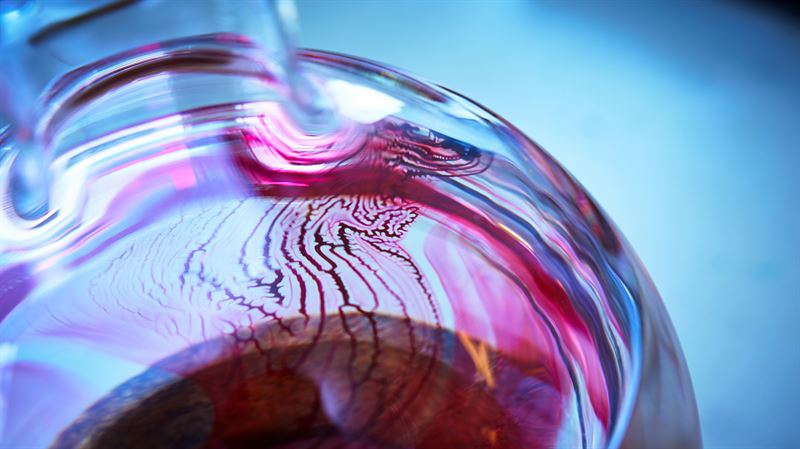
Almost immediately, the transparent solution begins to change colour as the building blocks start to assemble into polymer chains. These larger and longer molecules form the basis of the conductive plastic.
Once the colour has changed from yellow to deep red and then to deep purple, the reaction is complete. The mixture is then washed using several different solvents to remove impurities. Finally, the solvents are removed using rotary evaporation – a method similar to distillation.
After the separation process, a glittering gold-coloured substance remains, the colour being an indication that the material is electrically conductive. The production of the conductive plastic is now complete.
Read previous press releases on conductive plastics
The silk thread that can turn clothes into charging stations
Huge potential for electronic textiles made with new cellulose thread
Breakthrough in organic electronics
For more information, please contact:
Joost Kimpel, PhD student, Department of Chemistry and Chemical Engineering, Chalmers University of Technology, Sweden, kimpel@chalmers.se
Christian Müller, Professor, Department of Chemistry and Chemical Engineering, Chalmers University of Technology, Sweden, +46 31 772 27 90, christian.muller@chalmers.se
Joost Kimpel speaks English and Dutch, Christian Müller speaks English, German and Swedish.
At Chalmers, we have podcast studios and film equipment on site and can assist with requests for TV, radio or podcast interviews.
Find a selection of press images in the media section in this release.
All high-resolution images can be downloaded via this link.
Footage from the lab and explanatory videos can be downloaded via this link.
Caption for banner image: It’s mouldable, biocompatible and glitters like gold. Plastic that can conduct an electric charge is a material that can be used for everything from sensors that detect and even treat serious illnesses to self-cooling clothing or electronic adhesive plasters that can be applied to the skin and send data directly to a mobile phone. Researchers at Chalmers University of Technology in Sweden recently presented a ground-breaking ‘recipe’ that makes it easier to produce this kind of sought-after electrically conductive plastic in larger quantities and without harmful chemicals – in a more cost-effective way
Image credit: Chalmers University of Technology | Henrik Sandsjö
Mia Halleröd Palmgren
Press Officer
+46 31 772 32 52
mia.hallerodpalmgren@chalmers.se
________________
Chalmers University of Technology in Gothenburg, Sweden, conducts research and education in technology and natural sciences at a high international level. The university has 3100 employees and 10,000 students, and offers education in engineering, science, shipping and architecture.
With scientific excellence as a basis, Chalmers promotes knowledge and technical solutions for a sustainable world. Through global commitment and entrepreneurship, we foster an innovative spirit, in close collaboration with wider society.
Chalmers was founded in 1829 and has the same motto today as it did then: Avancez – forward.
---
Images provided in Chalmers University of Technology press releases are, unless specified otherwise, free for download and publication as long as credit is given to the University and the individual creator. Cropping and rescaling of the images is permitted when required for adaptation to the publication’s format, but modifications that would influence the message and content of the original are not. The material is primarily intended for journalistic and informative use, to assist in communication and coverage of Chalmers’ research and education. Commercial usage, for example the marketing of goods and services, is not permitted.
We kindly request credit to be given in the following format where possible:
Image/Graphic/Illustration: Chalmers University of Technology | Name Surname