
Stardust study resets how life’s atoms spread through space
Starlight and stardust are not enough to drive the powerful winds of giant stars, transporting the building blocks of life through our galaxy. That’s the conclusion of a new study from Chalmers University of Technology, Sweden, of red giant star R Doradus. The result overturns a long-held idea about how the atoms needed for life are spread.
“We thought we had a good idea of how the process worked. It turns out we were wrong. For us as scientists, that’s the most exciting result”, says Theo Khouri, astronomer at Chalmers and joint leader of the study.
To understand the origins of life on Earth, it’s important for astronomers to understand how giant stars power their winds. For decades, scientists have believed that winds from red giant stars – which seed the galaxy with carbon, oxygen, nitrogen and other elements essential for life – are powered when starlight pushes against grains of newly formed dust. The new observations of R Doradus challenge this picture.
Red giant stars are the older, cooler cousins of the Sun. As they age, they lose large amounts of material through stellar winds, enriching the space between stars with the raw ingredients for future planets and life. Despite their importance, the physical mechanism driving these winds has remained uncertain.
Astronomers studying the nearby red giant star R Doradus have found that the tiny grains of stardust surrounding the star are too small to be pushed outward by starlight strongly enough to escape into interstellar space.
The study, led by researchers at Chalmers University of Technology, is published in the scientific journal Astronomy & Astrophysics.
“Using the world’s best telescopes, we can now make detailed observations of the closest giant stars. R Doradus is a favourite target of ours – it’s bright, nearby, and typical of the most common type of red giant”, says Theo Khouri.
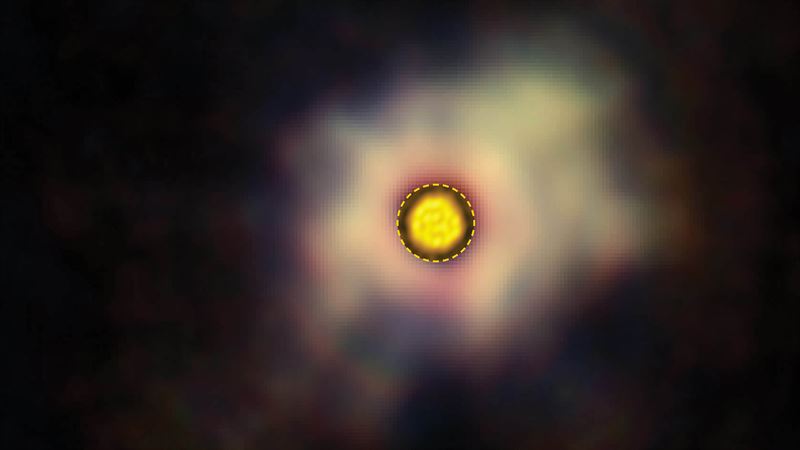
The team observed R Doradus using the Sphere instrument on ESO’s Very Large Telescope, measuring light reflected by dust grains in a region roughly the size of our Solar System. By analysing polarised light at different wavelengths, the researchers determined the size and composition of the grains, finding them consistent with common forms of stardust such as silicates and alumina.
The observations were then combined with advanced computer simulations that model how starlight interacts with dust.
“For the first time, we were able to carry out stringent tests of whether these dust grains can feel a strong enough push from the star’s light”, says Thiébaut Schirmer.
The push of starlight is not enough, the team was surprised to find. The grains surrounding R Doradus are typically only about one ten-thousandth of a millimetre across – far too small for starlight alone to drive the star’s wind into space.
“Dust is definitely present, and it is illuminated by the star”, says Thiébaut Schirmer. “But it simply doesn’t provide enough force to explain what we see.”
The findings point to other, more complex processes playing a major role. The team has previously used the ALMA telescope to capture images of enormous bubbles rising and falling on the surface of R Doradus.
“Even though the simplest explanation doesn’t work, there are exciting alternatives to explore,” says Wouter Vlemmings, professor at Chalmers and co-author of the study. “Giant convective bubbles, stellar pulsations, or dramatic episodes of dust formation could all help explain how these winds are launched.”
More about the research
The study, “An empirical view of the extended atmosphere and inner envelope of the asymptotic giant branch star R Doradus II. Constraining the dust properties with radiative transfer modelling”, is published in Astronomy & Astrophysics.
The research was carried out as part of the cross-disciplinary project “The origin and fate of dust in our Universe” funded by the Knut and Alice Wallenberg Foundation as a collaboration between researchers at Chalmers University of Technology, Sweden, and the University of Gothenburg, Sweden.
The team consists of Thiébaut Schirmer, Theo Khouri, Wouter Vlemmings, Gunnar Nyman, Matthias Maercker, Ramlal Unnikrishnan, Behzad Bojnordi Arbab, Kirsten K. Knudsen, and Susanne Aalto. All the co-authors are based at Chalmers University of Technology, Sweden, except Gunnar Nyman, at the University of Gothenburg, Sweden.
The team used the instrument Sphere (Spectro-Polarimetric High-contrast Exoplanet REsearch) on the Very Large Telescope (VLT), located at the Paranal Observatory in Chile. The VLT is operated by ESO, the European Southern Observatory. Sweden is one of ESO’s 16 member states.
More about the star
R Doradus is a red giant star located only 180 light years from Earth in the southern hemisphere constellation of Dorado, the Swordfish. Born with a mass similar to the Sun’s, it is now nearing the end of its life. It’s an example of an AGB star (AGB = asymptotic giant branch). Such stars lose their outer layers to interstellar space in the form of dense stellar winds made of gas and dust. R Doradus loses the equivalent of a third of the Earth’s mass every decade. Other similar stars can lose mass hundreds or thousands of times faster. In the distant future, several billion years from now, the Sun is expected to become a star just like R Doradus.
For more information, please contact
Robert Cumming, astronomer and communicator, Onsala Space Observatory, Chalmers University of Technology, Sweden, robert.cumming@chalmers.se, +46 704 93 31 14
Theo Khouri, astronomer, Chalmers University of Technology, Sweden, +46 31 772 63 54 theo.khouri@chalmers.se
Wouter Vlemmings, professor, Chalmers University of Technology, Sweden, +46 31 772 55 16, wouter.vlemmings@chalmers.se
Robert Cumming speaks Swedish and English, Theo Khouri speaks English and Portuguese and Wouter Vlemmings speaks English and Dutch.
Captions and credits:
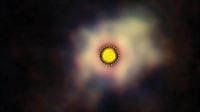
Banner image: Dust clouds reflect starlight around the star R Doradus. As it nears the end of its life, the star is shedding its outer layers, forming clouds of gas and dust around it (shown here in pink and yellow). Scientists have long believed that starlight illuminating these clouds could power a stellar wind. But the colour of the light around the star reflected by dust, shows that the dust grains are too small to explain the star’s wind. The image was taken in polarised visible light with VLT/SPHERE. In the centre in yellow and orange, we see ALMA’s image showing the surface of the star.
Credit: ESO/T. Schirmer/T. Khouri; ALMA (ESO/NAOJ/NRAO)
Images below:
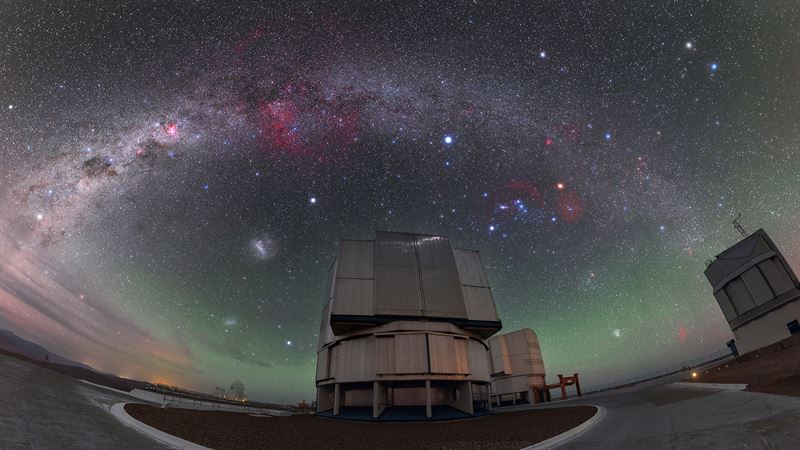
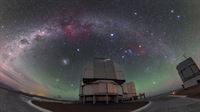
Caption: The sky above ESO’s VLT (Very Large Telescope) in Chile. The star R Doradus lies just to the left of the telescope at the centre of the image, close to the Large Magellanic Cloud, here visible as a bright fuzzy patch in the sky.
Credit: P. Horálek/ESO
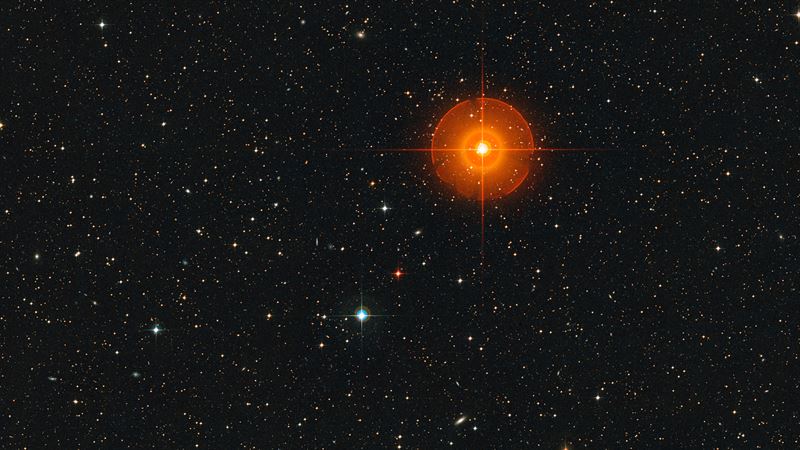
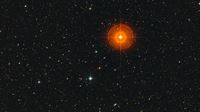
Caption: Wide-field view of the region of the sky around the star R Doradus.
Credit: ESO/Digitized Sky Survey 2/Davide De Martin
Henrik Dahlberg
Head of Media Relations
+46-31-772 1940
henrik.dahlberg@chalmers.se
________________
Chalmers University of Technology in Gothenburg, Sweden, conducts research and education in technology and natural sciences at a high international level. The university has 3100 employees and 10,000 students, and offers education in engineering, science, shipping and architecture.
With scientific excellence as a basis, Chalmers promotes knowledge and technical solutions for a sustainable world. Through global commitment and entrepreneurship, we foster an innovative spirit, in close collaboration with wider society.
Chalmers was founded in 1829 and has the same motto today as it did then: Avancez – forward.
---
Images provided in Chalmers University of Technology press releases are, unless specified otherwise, free for download and publication as long as credit is given to the University and the individual creator. Cropping and rescaling of the images is permitted when required for adaptation to the publication’s format, but modifications that would influence the message and content of the original are not. The material is primarily intended for journalistic and informative use, to assist in communication and coverage of Chalmers’ research and education. Commercial usage, for example the marketing of goods and services, is not permitted.
We kindly request credit to be given in the following format where possible:
Image/Graphic/Illustration: Chalmers University of Technology | Name Surname