ESS Achieves Beam on Dump: Accelerator Commissioning Underway
The European Spallation Source ERIC (ESS) has successfully achieved Beam on Dump, a major accelerator milestone and an important step towards commissioning of the entire ESS facility.
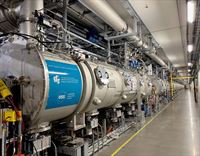
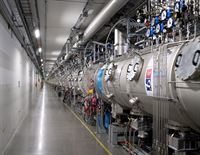
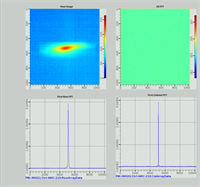
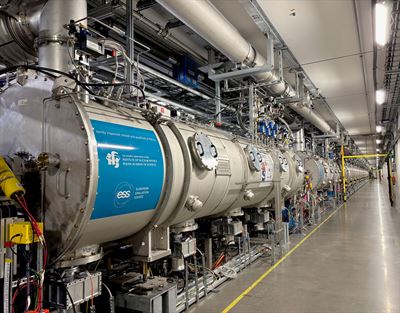
For the first time, protons have been accelerated to the correct energy and delivered all the way from the Ion Source to the Tuning Beam Dump – 542.5 metres down the accelerator tunnel. For the research facility currently under construction outside Lund, Sweden, this achievement demonstrates that the ESS accelerator is functioning as an integrated system, from source to dump. It is the culmination of years of design, manufacturing, testing, installation and integration, and represents a key step toward delivering high-power proton beams to the Target, where the first neutrons for scientific experiments will be produced.
– Beam commissioning is a major integration point where all our technical systems, infrastructure, controls, and processes must work effectively together. It’s also a dedicated period for identifying and resolving issues to ensure reliable accelerator operation in the future, says Ciprian Plostinar, Head of Accelerator Division, and continues:
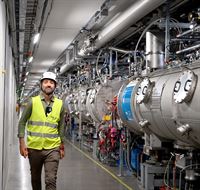
– The dedicated professionals here at ESS have demonstrated incredible determination, resilience, and teamwork. Control room staff, engineers, physicists, and technicians have been working tirelessly around the clock to make this possible. It’s a true testament to our shared mindset, expertise and commitment.
Reaching this milestone is the result of a long and challenging journey, from early design through installation, integration, and rigorous testing. The achievement is also the result of strong collaboration with ESS’ In-Kind partners across Europe. Contributions from member countries – including RF systems, cryomodules, diagnostics, vacuum systems, controls, and infrastructure – are now integrated and operating as one machine.
Looking Ahead: Beam on Target and First Neutrons
The next phase at ESS will focus on tuning the beam quality and slowly increasing the power level, preparing for Beam on Target – the moment when protons strike the tungsten target to produce neutrons for science. Helmut Schober, Director General of ESS, says:
– Beam commissioning is the gateway to ESS’s scientific mission. We are entering a decisive phase. With Beam on Dump, we know the accelerator works as a system. Now we look ahead to Beam on Target and producing our first neutrons. This is where ESS begins to fulfil its promise as a world-leading research facility, opening up the world of materials.
press@ess.eu
Ulrika Hammarlund +46 721 79 21 59
Anna-Maria Havskogen +46 705 69 70 12
About ESS
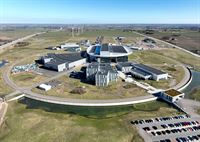
The European Spallation Source (ESS) is a multidisciplinary research facility under construction in Lund, Sweden, with its Data Management and Software Centre located at the Technical University of Denmark outside Copenhagen. The facility, owned by 13 European countries, is built with extensive contributions from many European In-Kind partner institutions and is projected to be operational by 2028. Once complete, it will be the world’s most powerful accelerator-based neutron source.
- The ESS accelerator and beam transport system is 600 metres long and will accelerate protons to 96% of the speed of light.
- It includes superconducting accelerating structures cooled by a helium cryoplant operating at 2 Kelvin.
- Protons are generated at the Ion Source and will be sent through the linear accelerator toward a rotating tungsten target station. When the high-energy protons collide with the heavy metal target, neutrons are released - a process called spallation. The neutrons are then guided to various experimental stations, where researchers can study materials at the atomic and molecular level.
- The accelerator will ultimately deliver proton beams of up to 5 MW of power to the target.
- ESS will enable scientific breakthroughs in fields such as materials science, energy, environmental research, transport, medicine, and health.
Tags: