Finnfund's Economist Tangeni Shatiwa: A weaker dollar is steering global investors toward emerging markets

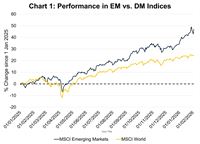
International investors are now allocating funds to emerging market (EM) assets at the fastest pace seen in years. The main drivers are a weaker U.S. dollar and a desire to diversify portfolios away from the United States. It is therefore no surprise that emerging market assets have risen sharply; for example, the MSCI EM Index has climbed 47 per cent over the past year.
“We believe that investing in emerging markets is currently highly attractive. Many of Finnfund’s target markets are projected to grow faster than advanced economies in the coming years, and even in the event of a global recession, emerging markets today are better protected against external shocks than in the past,” says Finnfund´s economist Tangeni Shatiwa.
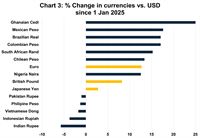
The rapid rise of the MSCI EM Index has clearly outpaced the 24 per cent increase in the benchmark index tracking developed markets (see Chart 1). At the same time, several emerging market currencies, such as the Ghanaian cedi and the South African rand, have strengthened by more than 10 per cent against the dollar. This trend has been accelerated by the volatile economic policies of Trump’s second term.
“This points to significant potential for further inflows as global portfolios seek diversification after a prolonged period of concentration in the United States. We consider this highly encouraging for emerging markets,” Shatiwa notes.
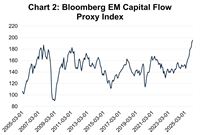
Historically, movements in the dollar have been a key driver of capital flows to emerging markets (Chart 2). Since the 1970s, every period of pronounced U.S. dollar weakness has fueled clear outperformance in emerging market investments.
“If the dollar continues to weaken, emerging market investments stand to gain significantly. Although many emerging market governments have increased borrowing in their own currencies in recent years, many still hold substantial dollar-denominated debt. A weaker dollar makes servicing that debt more affordable (Chart 3). In addition, a weaker dollar boosts revenues from commodity exports, as international trade is largely priced in dollars—and many emerging economies depend on and benefit from these revenues,” Shatiwa emphasises.
Valuations remain highly attractive
The positive outlook for emerging market investing is not based solely on capital shifting away from the United States. Valuations remain very attractive, with the MSCI EM Index currently trading at roughly a 40 per cent discount relative to the U.S. S&P 500 Index.
“If U.S. technology companies ultimately achieve the high earnings expectations promised by artificial intelligence, the same applies to emerging market technology firms—especially in Asia. Investors can therefore gain exposure to the same megatrend at a significantly lower price.”
Although emerging economies’ GDP has typically grown much faster than that of advanced economies over the review period, investments in emerging markets have often underperformed expectations. It took until 2021 for MSCI’s index tracking the largest emerging market companies to recover to its 2007 peak—only to fall sharply again by more than 40 per cent in 2022–2023.
While investing in emerging markets remains riskier than investing in developed economies, Shatiwa believes the level of risk is nevertheless lower than before. Emerging markets are also clearly better prepared for global shocks than in the past. This is especially important when trying to understand how severe the fallout from the recent breakout of the Middle East conflict will be for emerging markets, even though it remains uncertain how long-lasting this will be.
In recent years, middle-income countries in Latin America and Asia have strengthened their institutions and increased foreign exchange reserves to shield their economies from global turbulence.
“Many African countries, such as Ghana, Nigeria, and South Africa, have followed suit by implementing reforms to enhance economic resilience. Emerging markets demonstrated their resilience in 2022, when global inflation accelerated and many emerging market central banks raised policy rates well before the U.S. Federal Reserve and the European Central Bank in order to curb price pressures”, reminds Shatiwa.
For more information and material requests
Economist Tangeni Shatiwa, tangeni.shatiwa@finnfund.fi, tel. +358 40 562 8917
Chief Communications Officer Unna Lehtipuu, unna.lehtipuu@finnfund.fi, tel. +358 40 624 0896
Finnfund is a Finnish development financier and impact investor. Finnfund builds a sustainable future and generates lasting impact by investing in businesses that solve global development challenges with Finnish added value. Each year, we invest 200–250 million euros in 20–30 companies in developing countries. Our focus is particularly on digital infrastructure and solutions, clean energy, forestry, agriculture, and on providing funding for small and medium-sized enterprises through financial institutions. Today, Finnfund’s investments, commitments, and investment decisions total about 1.3 billion euros. The company has about 100 employees based in Helsinki and Nairobi. For more information, please visit https://www.finnfund.fi/en.