How Can Sustainable Chemistry Strengthen Europe’s Global Leadership in a Nature-Positive Economy?
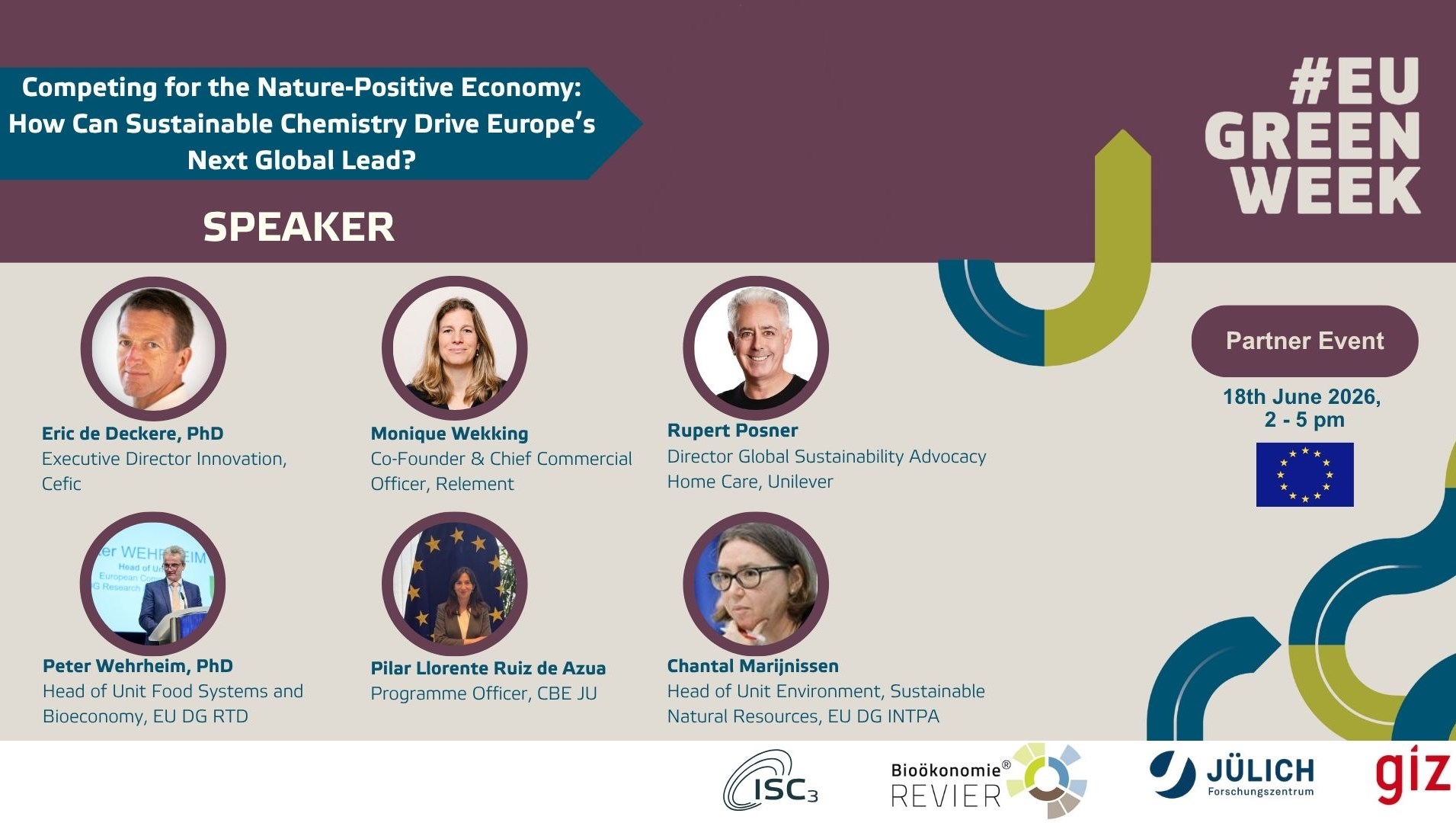
ISC3 and the Bioeconomy Revier Rhineland invite stakeholders to a high-level EU Green Week Partner Event in Brussels on 18 June 2026
The global race towards a sustainable and nature-positive economy is accelerating. Regions across Asia as well as North and South America are increasingly investing in bio-based innovation, circular production systems, and sustainable value chains. In response to these developments, the International Sustainable Chemistry Collaborative Centre (ISC3), together with the Bioeconomy Revier Rhineland, will host a high-level event in Brussels on 18 June 2026 as part of the EU Green Week 2026.
Under the title “Competing for the Nature-Positive Economy: How Can Sustainable Chemistry Drive Europe’s Next Global Lead?”, policymakers, industry leaders, researchers, and international innovation stakeholders will discuss how Sustainable Chemistry can help transform Europe’s innovation strengths into global competitiveness, industrial transformation, and sustainable economic growth.
“Europe has all the prerequisites to become a global frontrunner in the nature-positive economy. Sustainable Chemistry connects innovation, industrial transformation, and ecosystem regeneration. As such, it can play a decisive role in strengthening Europe’s competitiveness, creating new value chains, and reducing dependency on fossil resources,” says Thomas Wanner, Managing Director of ISC3.
“International cooperation is essential to position sustainability and quality standards and to ensure that bio-based and circular economies can deliver resilient and sustainable growth without locking in legacy systems,” says Romina Laumann, Director Strategic Alliances at ISC3. “Strengthening collaboration across regions enables the scaling of sustainable innovation and the development of competitive, future-oriented value chains that can support Europe’s leadership in the nature-positive economy.”
High-Level Speakers from Policy, Industry and Innovation
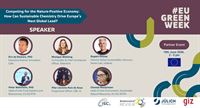
The event will bring together leading representatives from European institutions, industry associations, companies, and innovation ecosystems. Confirmed speakers include:
- Chantal Marijnissen, Head of Unit Environment, Sustainable Natural Resources EU Directorate General for International Partnerships (INTPA)
- Peter Wehrheim, Head of Unit Bioeconomy and Food Systems, EU Directorate for Research and Innovation, RTD
- Eric de Deckere, Executive Director Innovation, European Chemical Industry Council, CEFIC
- Rupert Posner, Director Global Sustainability Advocacy Home Care, Unilever
- Monique Wekking, Co-Founder & Chief Commercial Officer, Relement
- Pilar Llorente Ruiz de Azua, Programme Officer, Circular Bio-based Europe Joint Undertaking (CBE JU)
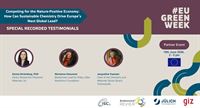
Additionally, the event will feature special recorded testimonials from the Ellen Mc Arthur Foundation, Chemistry NL and the IVL Swedish Environmental Research Institute.
Together with additional international partners from Europe, India, and the Mercosur region, they will explore how bio-based, circular, and resource-efficient solutions can accelerate Europe’s industrial transformation while strengthening international cooperation and future-oriented value chains.
From Vision to Action
Moving beyond traditional conference formats, the event is designed to foster active exchange between policymakers, industry representatives, researchers, and civil society. Participants can expect a moderated expert conversation, practical industry insights, perspectives from international innovation ecosystems, and an interactive fishbowl discussion format that actively engages the audience.
Key questions include:
- How can Europe translate its innovation leadership into sustainable competitiveness?
- What role can Sustainable Chemistry and sustainable biobased innovation play in enabling a nature-positive economy?
- How can new global value chains be established through international cooperation? How shall EU engage with international leaders and discuss standards for a nature-positive economy?
- Which policy and market conditions are needed to successfully scale sustainable innovation?
As an official partner event of EU Green Week 2026, the event aims to provide a platform for identifying practical pathways towards a resource-efficient, circular, and nature-positive economy.
Register Now and Secure Your Spot – Free Participation
The event will take place on 18 June 2026 from 14:00 to 17:00 CET at the Representation of the Deutsche Gesellschaft für Internationale Zusammenarbeit (GIZ) to the European Union in Brussels.
Participation is free of charge. Due to limited capacity, early registration is strongly recommended.
Registration: contact@isc3.org
Further information about the programme and event: https://isc3.org/page/eu-green-week-partner-event
Media Contacts
Christian Ruth-Strauß
Director Communications ISC3
christian.ruth-strauss@isc3.org
René Sutthoff
Konsequent PR
sutthoff@konsequent-pr.de
About the International Sustainable Chemistry Collaborative Centre (ISC3)
The International Sustainable Chemistry Collaborative Centre (ISC3) advances the global transition to Sustainable Chemistry across chemical value chains with cross-sectoral impact. The chemical industry is deeply interconnected with almost all areas of the economy and shapes the lives of people worldwide.
ISC3 promotes a holistic sustainability approach that embeds sustainable technologies, processes and products throughout supply chains. Products are considered across their entire life cycle – from design and production to use and further processing. This approach integrates environmental, economic and social dimensions, supports the closing of material loops within a circular economy, and fosters new efficiency- and sustainability-oriented business models. At the same time, ISC3 promotes a shift in thinking among stakeholders by advancing sufficiency strategies, helping to reduce the absolute consumption of materials, resources and energy, and encouraging solutions that are aligned with actual needs.
The Centre follows a multi-stakeholder approach, bringing together policymakers, public and private actors, industry, academia and civil society worldwide. It strengthens expertise and sustainability competencies, contributes to international chemicals policy, advises organisations, promotes innovation and entrepreneurship, and develops education and training programmes. In addition, ISC3 initiates strategic alliances to accelerate the transition to Sustainable Chemistry.
ISC3 was established in 2017 on the initiative of the German Federal Ministry for the Environment, Climate Action, Nature Conservation and Nuclear Safety (BMUKN) and the German Environment Agency (UBA). The Centre is hosted by the Deutsche Gesellschaft für Internationale Zusammenarbeit (GIZ) GmbH and supported by DECHEMA (Society for Chemical Engineering and Biotechnology) as the ISC3 Innovation Hub. www.isc3.org