ISC3 Announces Finalists for the Innovation Challenge 2026 "Sustainable Chemistry & Electronics”
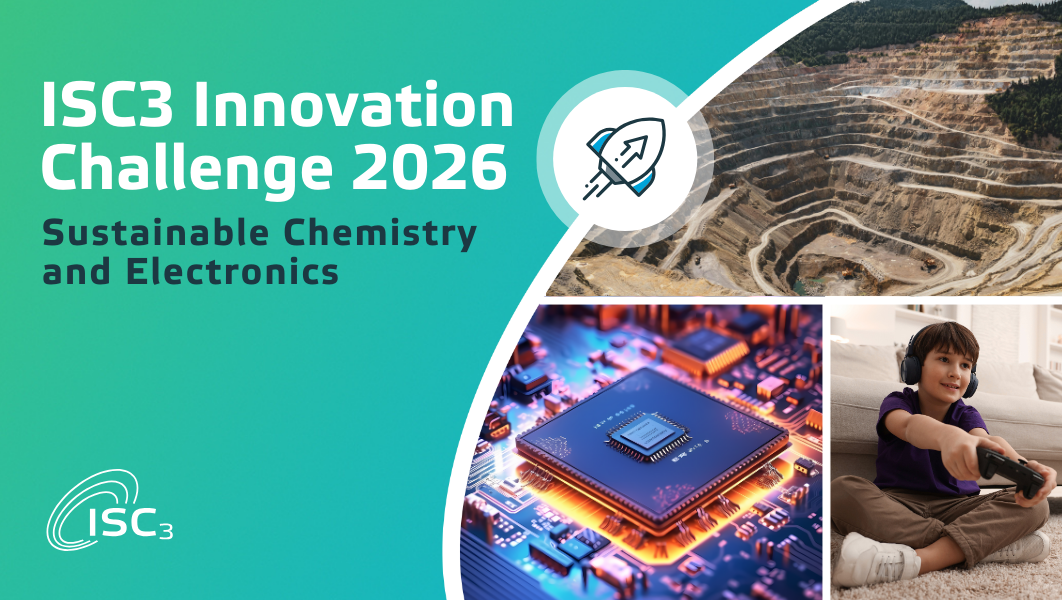
Eight international start-ups advance to the final, competing for €25,000 in prize money with breakthrough solutions for more sustainable electronics – Ready, set, here are the Changemakers!
What if the device in your pocket didn't come at a cost to the planet? What if the fastest-growing waste stream in the world could become the cleanest source of raw materials? What if hazardous chemistry in electronics manufacturing could be replaced with verified, safer processes? These are the questions at the heart of this year's ISC3 Innovation Challenge themed “Sustainable Chemistry & Electronics”. The International Sustainable Chemistry Collaborative Centre (ISC3) is proud to announce the eight finalists of its 7th Innovation Challenge. Selected from a field of over 50 applicants spanning more than 25 countries, the eight finalists earned their place in the final with innovative solutions addressing one of today's most pressing sustainability challenges: the electronics industry.
Why Electronics, Why Now
Electronics are everywhere − and so are their consequences. From toxic substances in components to mountains of e-waste and the high energy demand of semiconductor manufacturing, the sector's environmental footprint has long been treated as an unavoidable trade-off. ISC3 is challenging that assumption.
This year's call invited start-ups to rethink the chemistry behind our devices − and the responses were as diverse as the problem itself. The selected innovations range from solvent-free magnet recycling and next-generation battery electrolytes to AI-driven platforms for electronics traceability and bio-based adhesives for greener assembly. Other finalists focus on locally rooted e-waste solutions that integrate the informal sector into the circular economy, as well as modular, eco-designed electronic ear tags for animal health monitoring. Together, these innovations demonstrate the diversity of sustainable electronics innovation while reflecting a new generation of founders who see sustainability as a core design principle rather than an afterthought.
Chosen by Experts, Built for Impact
Selecting eight finalists from such a strong field was no small task. A jury of 15 independent experts − spanning Sustainable Chemistry, Electronics, Business, Innovation and Academia − brought a rigorous multi-lens perspective to the evaluation. “The quality and diversity of this year's applications send a clear signal: these founders are proving that Sustainable Chemistry and electronics innovation go hand in hand − and that is exactly the kind of work ISC3 exists to amplify," says Dr. Alexis Bazzanella, Director of the ISC3 Innovation Hub. ISC3 extends its sincere thanks to every jury member for the time and expertise they brought to this process.
The Eight Finalists
After a two-stage evaluation process, the following start-ups have earned their place in the final round of the ISC3 Innovation Challenge 2026 (listed alphabetically):
Afya Ya Mnyama Digital (Tanzania) has developed an eco-designed, modular smart ear tag sensor system that monitors the health of farm animals in real time – with a focus on reducing environmental impact throughout the device lifecycle.
AppCyclers (Ghana) is running a safe and community-driven digital e-waste recycling system − from collection, safe recycling and training to trading quality recycled products.
B-CIRC Botswana Circular Energy Storage Platform (Botswana) is building a four-device energy storage and solar-fuel platform aiming to source all active electrode and electrolyte material from Botswana waste streams or evaporite deposits.
Ecolyte (Azerbaijan) is replacing flammable electrolytes in lithium-ion batteries with ionic liquid-based gelthat have the potential to enhance battery efficiency, lifespan, and safety.
ON nano International (Germany) is offering the world`s first largest-area spin coater for glass-based circuit boards that enables highly uniform resist coating on ultra-thin material layers for next generation chip assembly while significantly reducing chemical and material consumption.
ReBond Technologies (Tanzania) is introducing a low-cost, bio-based reversible adhesive designed for electronic assembly and disassembly − improving material recovery and supporting circular electronics.
TSR Innovations (Germany) is developing a cost-efficient, closed-loop mechanochemical recycling process for end-of-life rare-earth magnets.
WeavInsight (Singapore) is building an AI-driven remote sensing and IoT platform that creates a "Chemical Digital Twin" for electronics to help detect and reduce material dissipation and toxic leakage.
What Happens Next
All eight finalists will receive tailored support through the ISC3 Global Start-up Service, including online pitch training, workshops, support from mentors and experts, and increased visibility through ISC3’s communication channels − among them the "Start-up of the Month" series, which spotlights best practices in Sustainable Chemistry to an international audience.
Following the pitch training, finalists will take the stage at electronica 2026 − one of the world’s leading trade fairs for electronic components and systems − taking place from 10 to 13 November 2026 in Munich, Germany. There, they will present their solutions and compete for the €15,000 main prize on 13 November. Two additional start-ups will each receive €5,000 in recognition of their outstanding impact. The finalists’ journey will culminate in the official ISC3 Innovation Challenge Award Ceremony.
The competition highlights ISC3's commitment to accelerating market-ready Sustainable Chemistry innovations that contribute to a more circular and resilient electronics sector.
Christian Ruth-Strauß
Director Communications ISC3
christian.ruth-strauss@isc3.org
René Sutthoff
Konsequent PR
sutthoff@konsequent-pr.de
About the International Sustainable Chemistry Collaborative Centre (ISC3)
The International Sustainable Chemistry Collaborative Centre (ISC3) advances the global transition to Sustainable Chemistry across chemical value chains with cross-sectoral impact. The chemical industry is deeply interconnected with almost all areas of the economy and shapes the lives of people worldwide.
ISC3 promotes a holistic sustainability approach that embeds sustainable technologies, processes and products throughout supply chains. Products are considered across their entire life cycle – from design and production to use and further processing. This approach integrates environmental, economic and social dimensions, supports the closing of material loops within a circular economy, and fosters new efficiency- and sustainability-oriented business models. At the same time, ISC3 promotes a shift in thinking among stakeholders by advancing sufficiency strategies, helping to reduce the absolute consumption of materials, resources and energy, and encouraging solutions that are aligned with actual needs.
The Centre follows a multi-stakeholder approach, bringing together policymakers, public and private actors, industry, academia and civil society worldwide. It strengthens expertise and sustainability competencies, contributes to international chemicals policy, advises organisations, promotes innovation and entrepreneurship, and develops education and training programmes. In addition, ISC3 initiates strategic alliances to accelerate the transition to Sustainable Chemistry.
ISC3 was established in 2017 on the initiative of the German Federal Ministry for the Environment, Climate Action, Nature Conservation and Nuclear Safety (BMUKN) and the German Environment Agency (UBA). The Centre is hosted by the Deutsche Gesellschaft für Internationale Zusammenarbeit (GIZ) GmbH and supported by DECHEMA (Society for Chemical Engineering and Biotechnology) as the ISC3 Innovation Hub. www.isc3.org