ISC3 Provides Guidance for Sustainable Chemistry: New Toolbox and Simplified Key Characteristics Support Businesses and Innovators

Free information resources make it easier to enter the field of Sustainable Chemistry and drive sustainable innovation
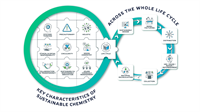
What defines Sustainable Chemistry? How can companies, start-ups, and public institutions systematically integrate sustainability into innovations, products, and processes? And where can stakeholders from industry, science, and policymaking find reliable information and practical guidance? The International Sustainable Chemistry Collaborative Centre (ISC3) addresses these questions with a new, comprehensive, and free set of resources. The simplified 10 Key Characteristics of Sustainable Chemistry explain the principles of this approach in an accessible way. Complementing them, the unique ISC3 Sustainable Chemistry Toolbox provides valuable access to numerous freely available online tools and databases, offering detailed information on international regulations, chemical substances, substance properties, sustainability aspects, and much more.
For the first time, the Sustainable Chemistry Toolbox brings together key international information sources, databases, assessment instruments, and software solutions in one place. By consolidating information that has often been fragmented, it enables companies, innovators, investors, and decision-makers to systematically integrate sustainability considerations into products, processes, and business models.
“As the International Sustainable Chemistry Collaborative Centre (ISC3), we want to share our knowledge and experience we have gained through collaboration with start-ups, companies, and experts around the world, and make it accessible to as many stakeholders as possible,” says Dr. Thomas Wanner, Managing Director of ISC3. “The Toolbox bundles essential information sources and provides an accessible entry point for organisations seeking to integrate sustainability into innovation processes. It helps ensure that sustainability is embedded systematically already during the development phase of innovations.”
The free resources are aimed at companies, start-ups, public institutions, non-profit organizations, investors, and stakeholders from science, education, and policymaking. They support users in systematically incorporating sustainability aspects into daily operations and strategic decisions. “The Key Characteristics and the Toolbox can serve as a guide, compass, and source of inspiration. They help develop solutions that create environmental, economic, and social value,” adds Dr. Dorota Bartkoviak, ISC3 Innovation Manager. The Toolbox is available free of charge at www.isc3.org/page/key-characteristics-of-sustainable-chemistry.
Sustainable Chemistry as a Driver of Transformation
This approach considers the impacts of substances, materials, and processes throughout their entire life cycle, from raw material extraction and use to reuse or disposal. Environmental, economic, and social aspects are taken into account equally. It is therefore far more than an approach to reducing environmental impacts. It is a key enabler of climate protection, resource efficiency, the circular economy, environmental and human health protection, and future-oriented industrial development.
Comparing Substances and Assessing Sustainability
The Sustainable Chemistry Toolbox brings together a wide range of powerful and freely accessible tools. Users gain access to databases for chemical substances and their properties, instruments for assessing the sustainability of chemicals and materials, and applications for evaluating environmental and health impacts. Databases such as ChemSpider, ChemSelect, and PubChem allow users to examine well over one hundred million substances.
While established platforms such as PubChem and ChemSpider provide extensive information on chemical compounds, the responsibility for sustainability assessment generally remains with the users. They must interpret the available data according to their own criteria, such as environmental, health, and safety considerations. Searches can be performed using chemical names, molecular formulas, and structures, and ChemSpider additionally supports spectral data searches.
ChemSelect goes a decisive step further. The platform enables standardized sustainability assessments and direct comparisons of chemicals and mixtures. Users can quickly create sustainability profiles, compare results across environmental, health, and safety criteria, benefit from automated evaluations, and receive easily understandable classifications through an intuitive traffic light classification system.
Software Tools for Sustainable Innovation
Another important component of the Toolbox consists of free software applications such as QSAR Toolbox and OpenLCA. QSAR Toolbox enables users to assess chemical hazards using quantitative structure–activity relationships. Based on structural similarities, users can predict toxicological, ecotoxicological, and physicochemical properties of chemicals and derive estimates based on existing data and mechanistic knowledge. The free software was developed by the Organisation for Economic Co-operation and Development (OECD) and the European Chemicals Agency (ECHA).
OpenLCA, an open-source software application available free of charge, allows users to quantify environmental impacts across the entire life cycle of a product, from raw material extraction to disposal or recycling. The Toolbox also includes a structured portfolio of digital tools and approaches designed to help users integrate sustainability into every phase of the life cycle of products, processes, innovations, and projects. One example is the UNEP Green Chemistry Toolkit, a practical package of guidance materials for applying Sustainable Chemistry principles, including step-by-step instructions and case studies. Developed by the United Nations Environment Programme (UNEP), it provides tools that enable small and medium-sized enterprises to identify opportunities for improvement even with limited resources or technical expertise.
Another example is the Safe and Sustainable by Design (SSbD) Toolbox. Developed within the framework of the Partnership for the Assessment of Risks from Chemicals (PARC), it is a structured collection of digital tools, models, methods, and databases that supports designers, researchers, and companies in integrating safety, environmental sustainability, and functionality at the earliest stages of chemical and material innovation.
Available Free of Charge Starting Now
“Sustainable Chemistry is not a vision for tomorrow. It is a fundamental prerequisite for the transformation of our economies and societies. With these new resources, we aim to make knowledge accessible and provide concrete pathways for action,” says Wanner.
The simplified 10 Key Characteristics of Sustainable Chemistry and the ISC3 Sustainable Chemistry Toolbox are now available free of charge on the ISC3 website.
Explore the Toolbox and learn more at: www.isc3.org/page/key-characteristics-of-sustainable-chemistry
Media Contact
Christian Ruth-Strauß
Director Communications ISC3
christian.ruth-strauss@isc3.org
René Sutthoff
Konsequent PR
sutthoff@konsequent-pr.de
About the International Sustainable Chemistry Collaborative Centre (ISC3)
The International Sustainable Chemistry Collaborative Centre (ISC3) advances the global transition to Sustainable Chemistry across chemical value chains with cross-sectoral impact. The chemical industry is deeply interconnected with almost all areas of the economy and shapes the lives of people worldwide.
ISC3 promotes a holistic sustainability approach that embeds sustainable technologies, processes and products throughout supply chains. Products are considered across their entire life cycle – from design and production to use and further processing. This approach integrates environmental, economic and social dimensions, supports the closing of material loops within a circular economy, and fosters new efficiency- and sustainability-oriented business models. At the same time, ISC3 promotes a shift in thinking among stakeholders by advancing sufficiency strategies, helping to reduce the absolute consumption of materials, resources and energy, and encouraging solutions that are aligned with actual needs.
The Centre follows a multi-stakeholder approach, bringing together policymakers, public and private actors, industry, academia and civil society worldwide. It strengthens expertise and sustainability competencies, contributes to international chemicals policy, advises organisations, promotes innovation and entrepreneurship, and develops education and training programmes. In addition, ISC3 initiates strategic alliances to accelerate the transition to Sustainable Chemistry.
ISC3 was established in 2017 on the initiative of the German Federal Ministry for the Environment, Climate Action, Nature Conservation and Nuclear Safety (BMUKN) and the German Environment Agency (UBA). The Centre is hosted by the Deutsche Gesellschaft für Internationale Zusammenarbeit (GIZ) GmbH and supported by DECHEMA (Society for Chemical Engineering and Biotechnology) as the ISC3 Innovation Hub. www.isc3.org