Sustainable Chemistry Changemakers: The Path to a More Sustainable Future
Natupla: From ISC3 Start-up of the Month to a Pioneer in Starch-Based, Biodegradable Plastics
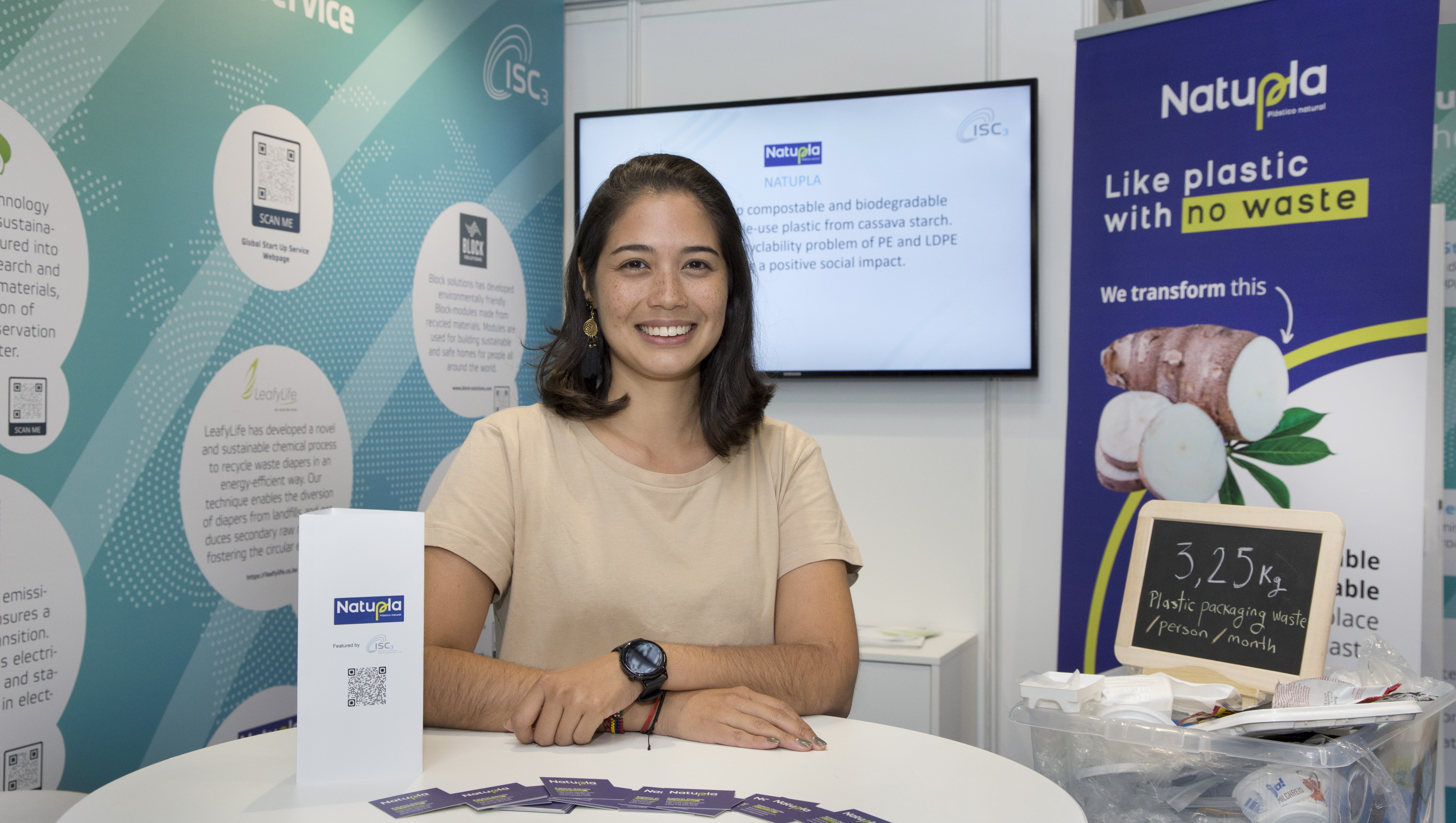
For its contribution to Sustainable Chemistry, Natupla (Natural Plastic) was recognised as Start-up of the Month by the International Sustainable Chemistry Collaborative Centre (ISC3) in September 2022. The Colombian start-up, which had been founded just one year earlier, developed a starch-based alternative to plastic. Natupla’s innovative, biodegradable solution aims to replace single-use plastic packaging materials, such as those used for exported fruits and vegetables. By doing so, the company founded by Katerin Carrillo and her father Ramon is having a positive impact on the environment while simultaneously supporting local starch producers and farmers. Since receiving this recognistion, Natupla has made the transition from a laboratory-stage project to a fully developed, market-ready product manufactured in its own pilot plant. The next stage will be reached shortly.
The driving forces behind Natupla
Creating alternatives to plastics that are just as competitive, high-performance, versatile, and cost-effective, yet fully biodegradable – that is the goal the two founders have set for themselves. By doing so, they are addressing one of the most pressing environmental issues of our time. For more than five years, the Carrillos have been experimenting with their idea, which was originally sparked by their rejection of single-use plastics in their personal lives. The family-owned business initially focused on bio-based polymers for arts and crafts. Then they began to consider how they could use their expertise in starch-based polymers to replace single-use plastics. Katerin Carrillo and her father Ramon began developing a business model for producing packaging materials from locally sourced starch. Nearly four years after being recognised as Start-up of the Month, we spoke with Natupla about their progress, experiences, milestones, and the support they’ve received from the ISC3 Global Start-up Service.
What does Sustainable Chemistry mean to you?
Sustainable Chemistry is our “North star” for everything we do at Natupla. It is not just a part of our process, but the foundation of our entire business model. Because the concept of Sustainable Chemistry is leading the industry away from the retroactive reduction of environmental pollution toward a new way of thinking. The goal must be to bring only products to market that do not burden the environment in the first place. We align our business activities with the ISC3 Key Characteristics for Sustainable Chemistry. This ensures that we actively contribute to the circular economy.
We use renewable local feedstock to reduce our dependence on fossil fuels. We also avoid hazardous substances to ensure that our compounding process is safe for both our employees and the environment. From the very first step of the design process, we consider the entire lifecycle of our product — ensuring it can be fully returned to the nutrient cycle with biodegradability at its core.
Where do you stand today compared to when you were named “Startup of the Month”?
What began as a laboratory application has now become a market-ready product. We are currently expanding our production capacity to 20 tons per month. Our working conditions have also improved significantly. The core team consists of three experts working in a well-equipped laboratory, where we are vigorously driving the further development of our technology.
How have you benefited from the collaboration with ISC3 and the support provided by the ISC3 Global Start-up Service?
The ISC3 Global Start-up Service has been invaluable to us. Participating in the ISC3 programmes opened doors for us to key contacts in Germany and potential partners around the world. The networking was also crucial for understanding how we need to position our technology to meet international standards. In addition, it gave us a better overview of the global market. This was crucial for assessing technology trends and regulatory changes outside of Latin America. Having ISC3 experts at hand who grasp both the chemistry and the business side made a real difference — helping Natupla strike the right balance and sharpen its scaling strategy.
What have been the highlights of your journey so far?
The most significant milestone was our compostability pilot project in collaboration with GIZ, Acoplasticos, and ICIPC (Institute for Training and Research on Plastics and Rubber). It proved that our materials are compostable on both laboratory and pilot scale.
What does all this mean for your company?
Our progression is gaining public recognition. That’s very motivating. Our international profile was significantly boosted by a radio report on Deutsche Welle (DW) that highlighted our efforts to address the plastic crisis in Colombia. Additionally, being named ISC3 Startup of the Month has given us greater visibility in the market. Today, Natupla is supported by funding from the Colombian Ministry of Science and La Asociación Nacional de Empresarios de Colombia (ANDI).
Media Contact
Christian Ruth-Strauß
Director Communications ISC3
christian.ruth-strauss@isc3.org
René Sutthoff
Konsequent PR
sutthoff@konsequent-pr.de
About the International Sustainable Chemistry Collaborative Centre (ISC3)
The International Sustainable Chemistry Collaborative Centre (ISC3) advances the global transition to Sustainable Chemistry across chemical value chains with cross-sectoral impact. The chemical industry is deeply interconnected with almost all areas of the economy and shapes the lives of people worldwide.
ISC3 promotes a holistic sustainability approach that embeds sustainable technologies, processes and products throughout supply chains. Products are considered across their entire life cycle – from design and production to use and further processing. This approach integrates environmental, economic and social dimensions, supports the closing of material loops within a circular economy, and fosters new efficiency- and sustainability-oriented business models. At the same time, ISC3 promotes a shift in thinking among stakeholders by advancing sufficiency strategies, helping to reduce the absolute consumption of materials, resources and energy, and encouraging solutions that are aligned with actual needs.
The Centre follows a multi-stakeholder approach, bringing together policymakers, public and private actors, industry, academia and civil society worldwide. It strengthens expertise and sustainability competencies, contributes to international chemicals policy, advises organisations, promotes innovation and entrepreneurship, and develops education and training programmes. In addition, ISC3 initiates strategic alliances to accelerate the transition to Sustainable Chemistry.
ISC3 was established in 2017 on the initiative of the German Federal Ministry for the Environment, Climate Action, Nature Conservation and Nuclear Safety (BMUKN) and the German Environment Agency (UBA). The Centre is hosted by the Deutsche Gesellschaft für Internationale Zusammenarbeit (GIZ) GmbH and supported by DECHEMA (Society for Chemical Engineering and Biotechnology) as the ISC3 Innovation Hub.