From Insight to Action: Summary of Misunderstood Headwind 2025 Power Talk at the Green Power Summit
At Green Power Sweden Summit on Oct 14, the Peerpointing initiative and Renewable Sweden gave an appreciated Power Talk on a just-launched report about innovative and important acceptance work regarding renewable energy development. The results are hard to look away from.
Even the corridor next to the lounge scene's seating area quickly filled up when the report “Missuppfattad motvind 2025” (freely translated as Misperceived Headwinds 2025) was swiftly presented and discusseed. Not a single cell phone camera lay idle as the problematic conclusions were presented one by one:
- The majority wants more wind power in their own municipality – but we don’t perceive this to be the case.
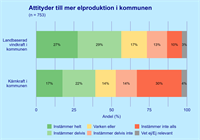
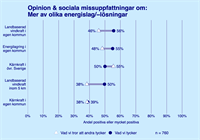
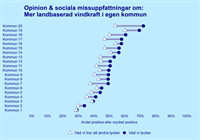
In the project's nationally representative sample (760 replies), 56 % were positive towards new land-based wind power development in their municipality, whereas the average estimation of the support was 46 %. In polling, ten percentage points is of course always a considerable gap, and the dynamic of perceived-minority-but-actual-majority makes the discrepancy even more problematic.
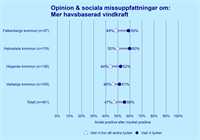
For the thirteen municipalities that the project zoomed in on (around 500 replies in each), the perception gap was smaller in some and larger in some, but it was always there. In around half of them the perceived support was below 50 % despite the opposite actually being the case. (The latter was also the case for all four southern Swedish west coast municipalities for which the project gathered indicative, small-sample data about support for offshore wind: Falkenberg, Halmstad, Höganäs and Varberg.)
- We especially underestimate rural residents' support for wind power.
Most of the misperception in point 1 is driven by an underestimation of the support that rural residents have for increasing wind power generation in their municipality. In this group on the national level, 43 % are positive – but the average perception is that only 30 % are positive. In other words, attitudes towards wind power aren’t as hostile in rural areas decision-makers might think.
Moreover, the fact that 43 % are positive doesn't mean that the rest are negative, since many express neutral sentiments. Only 37 % of rural residents said they are negative. The same number for all respondents – point 1 – was 23 %. There was no noteworthy misperception when it comes to wind power support among town and city dwellers.
- Support for the municipal wind‑power veto in its current form is quite low but is overestimated quite a lot.
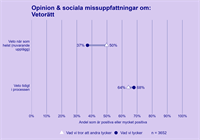
Only 37 % of respondents nationally want the current veto design to remain in place, but Swedes think that 50 % do. Since the veto so far this year has been used 97 % of the time in when municipal policymakers have made decisions on proposed wind power projects, it's not hard to imagine that correcting this misperception would make a difference in the number of permits eventually given out.
Support was high – 68 % – for reforming the veto so that municipalities only early on the process can stop applications from being assessed by the county administrative boards. The project saw no real social misperception regarding this support, with estimated support at 64 % on average.
- Municipal policymakers seem to have an even poorer understanding of public opinion.
The project also invited municipal policymakers to respond to an adapted version of the web survey. In comparison with the gold standard sampling-and-recruitment process for the public – randomisation, stratification, mixed-methods outreach (postal, text message, digital mailbox), weighting – this target group was only invited through emails. As expected, both from this reality and from experience of other, more expensive methods, the response rate among the politicians was low: 13 % compared to 28 % for the public.
Hence the word "seem" in the heading. Still, the patterns in the 222 replies from the mentioned thirteen municipalities are interpreted as highly indicative since they mirror the public's results closely – including the underestimation of support for more wind power locally. If anything, voters' chosen representatives seem to hold larger misperceptions about voters' views than the voters themselves do. Quite problematic. These results are in line with for example robust British and German research on many different topics that arrives at the same conclusion, that policymakers tend to have larger social misperceptions than the public.
- The problem/opportunity is larger for certain energy sources (especially wind) than for others (e.g. nuclear).
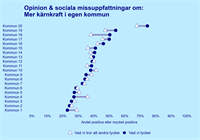
While the project saw consistent underestimation of wind power support, the same was not the case for nuclear. For wind, the pattern was clear: in all 20 municipalities for which the project got sufficient samples (at least 50 replies but in most cases up to ten times as large), there wasn't a single overestimation on the level of the whole municipality.
When it comes to support for new nuclear power in one's own municipality, the pattern instead looked random and the perception gaps were much smaller. Two percentage point underestimation here, three percentage point overestimation there. This means that for some reason, Swedes have a much clearer understanding of people's opinions concerning nuclear power than concerning wind power. Obvious candidates for contributing factors are disinformation and a well-organised opposition that manages to get disproportionate attention. This is of course not good, but it also means that the dominant (social) media narrative of wind power in Sweden doesn't correctly reflect actual public sentiment, so if we clear up the fog there's room for swift improvement.
Based on opinion polling from across the country, jointly financed by a dozen renewable‑energy stakeholders, the project was led by the Peerpointing initiative, represented on stage by freelancer climate and behavior strategist Tim Isaksson. Renewable Sweden didn't formally participate but provided the project with input and contacts during the spring. Being able to jointly present the Power Talk therefore came naturally and was a mutually rewarding wind-up of this first phase of peer pointing in the sector (the word is also a verb: to identify and counteract so-called social misperceptions).
Social misperceptions are far from innocent curiosities
Tim explained that several problems arise when we have inaccurate ideas of what fellow citizens or voters think. Since we are deeply social beings who go to great lengths not to be excluded from the group, social misperceptions can lead to self‑censorship when one mistakenly believes their view is unpopular and does not want to stand out from the crowd. Misperceptions can also cause people to change their opinion “unnecessarily”, so as to conform to what they think is the majority view. The same mechanisms apply to leaders in politics and business, but the consequences there are even more direct and negative because it deprives leaders of perceived sufficient mandate to dare make the decisions needed and instead fall prey to the loud minority. In other words, social misperceptions can lead to us not building the society we actually want.
Some might argue, 'So we don't quite know what the Joneses think, that's not so surprising, what's the big deal?' But at scale this translates to a very real deficit in democratic governance. Research on social contagion and social movements shows that even seemingly small shifts in perceived public opinion can have outsized impact, catalysing large mobilisation on issues ranging from international armed conflict to family politics. If public support for positive change is systematically underestimated, what large transitions to a better world are unnecessarily impeded? Social misperceptions thus constitute a non-negligible threat to progress wherever they arise. Given the climate crisis and the requisite pace of decarbonisation, they also tangibly contribute to current and future suffering from the impacts of climate breakdown.
Implications for the renewables sector in Sweden and beyond
Renewable Sweden's founder and CEO Jeanette Lindeblad opened the presentation by stating that the increasingly non‑linear permitting processes bring new challenges for acceptance work, especially regarding securing permits for new wind farms. The company’s experience is that new approaches are needed to convince both municipal policymakers and the public that most residents actually passively give their strong support for renewable energy projects, but that their voices get drowned out in the debate (and this not mainly by legitimate concerns of affected residents).
Presenting opinion data in new packaging can be a valuable tool in such work, Jeanette continued. In combination with services for responsive citizen dialogue and active knowledge‑building activities – including modern visualization – that go beyond traditional consultations, we can ensure projects are not rejected simply because decision‑makers only hear from a small number of citizens and from vested interests.
Tim concluded the appreciated insights‑filled 15-minute session by agreeing on the need for new types of communication. The renewables industry is under great pressure right now, and one of the jigsaw pieces forward could be to harness the interesting opportunity that the social misperceptions after all provide. Low‑hanging “acceptance fruits” in the climate transition are there for the taking – new persuasion efforts often might not be needed. So step one is to make the silent majority more visible by showing decision‑makers data from projects like this. Step two is to create a safe space for the silent majority to speak up, by widely publicizing the positive social norms.
Many audience members wanted to talk with Tim and Jeanette afterward about ways forward. We welcome anyone interested to get in touch to find ways to collaborate. It's quite urgent that we make progress here. Almost at the end of the session, one industry representative asked how the misperceptions might be affected during the run-up to the Swedish election in September 2026. Our reply: they're not likely to decrease by themselves.
Questions or curious to learn more?
If you have any questions about the report or would like to explore how its findings can be applied in practice, feel free to get in touch:
Jeanette Lindeblad
VD Renewable Sweden
Telefon: + 46 (0) 70 605 44 41
E-post: jeanette.l@renewablesweden.com
Tim Isaksson
Initiativtagare Peerpointing
Klimat- & beteendestrateg, Felfritt
Telefon + 46 (0)702-32 89 93
E-post: timisaksson@protonmail.com
About Renewable Sweden and Peerpointing
With deep experience and a trust-based, locally grounded approach, Renewable Sweden develops solutions that are both sustainable and long-lasting.
Peerpointing is an initiative and method designed to identify and counteract social misconceptions about the green transition. By highlighting the gap between actual attitudes and what we assume about each other, Peerpointing supports more informed decision-making
Tags: