Scania’s new under-cab battery module and Megawatt Charging System now available for order
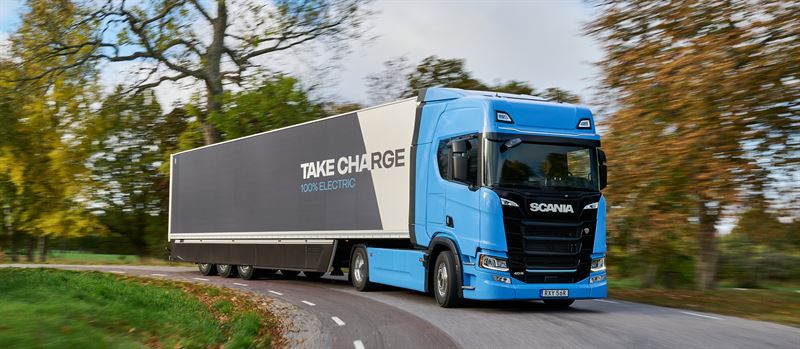
- Release to general sale of Scania’s new under-cab battery module makes it easier for hauliers to electrify fleets, with better balancing of payload, bodywork and range.
- Scania’s new Megawatt Charging System (MCS) speeds up battery recharging.
Scania has begun the global sales rollout of its new under-cab battery module, which for the first time enables operators to optimise battery capacity for the vast majority of transport needs. Heavy loads, advanced bodywork and long-haulage transport assignments can now be electrified with improved operational precision, and in some applications it’s now possible to achieve a range well beyond 800 km on one charge.
The positioning of the battery module under the cab of the Scania electric truck frees up more space for bodywork and successfully addresses the main issue on transporters’ minds: how to balance the needs of range, without it reducing the payload. A major benefit of the overall battery solution is that we can adapt its positions to cater for different types of bodywork across different applications.
In fact, the increase in Gross Train Weight allowance introduced by the European Union in 2025 means that Scania can deliver a 400-kWh usable capacity option for 360 km of typical range without needing to lower payload – all the way up to the legal maximum.
Scania’s MCS: key to the right battery charging strategy
Another factor for transport companies to bear in mind is that battery capacity does not necessarily limit the achievable range. A common misconception about electric trucks is that their battery capacity should always be large enough for the worst-case scenario, and always be optimised for maximum range, for example, 500 kilometres. However, if the transport assignment is only 300 kilometres, having the larger batteries is, in several use cases, unnecessary, and may affect the size of the payload.
Instead, it’s more about the charging strategy used for the job, and the introduction of Scania’s Megawatt Charging System (MCS) supports that need. Given the legally required rest breaks for the drivers, transporters can plan a battery charge during a journey at a natural stopping point, and top up from, say, 20 percent to 75 percent.
That is more than enough battery power to get the vehicle and its payload to the destination. A further charge could be done either at the delivery depot or on the way back to the truck’s base, all of which helps reduce both operating and capital expenditure.
“The new under-cab battery module optimises the placing of the truck batteries to transporters’ advantage,” says Tobias Ejderhamn, Global Manager, Transformation & New Business, Scania. “Thus, with the right battery set-up, MCS and a good charging strategy – using Scania’s own charging company Erinion or Scania Charging Access out on the road – our customers can easily solve the range versus payload question.”
“All of this just underlines the fact that haulage companies who choose Scania’s electric trucks are transporting goods, not kilowatt hours, and reducing their total cost of operation,” Ejderhamn says.
“Scania can now offer transport operators a comprehensive path to electrification and sustainable transport; one that is reliable, seamless, and commercially viable,” adds Lars Gustafsson, Head of Solutions Management, Scania. “With these two new additions to customers’ armoury it has become even easier and more attractive to make the change to electric transport.”
Explore Scania’s battery-electric trucks and charging solutions.
For further information, please contact:
Erik Bratthall
Corporate Public and Media Relations Manager, Scania
Phone: +46 76 724 45 27
E-mail: erik.bratthall@scania.com
Scania is a world-leading provider of premium transport solutions. Together with our partners and customers, we are driving the shift towards a sustainable transport system. Founded in Sweden in 1891, Scania now operates in more than 100 countries and employs around 53,000 people. Production takes place in Europe, Latin America and Asia. Research and development is carried out globally with our main site in Södertälje, Sweden. As part of the TRATON Group, we are empowered by shared industrial strength, scale and expertise to accelerate innovation and the shift towards a sustainable transport system. In 2025, Scania delivered 87,600 trucks, 6,500 buses and coaches as well as 9,200 industrial and marine power systems to our customers. Net sales totalled over SEK 198 billion, of which about 20 percent were services related. For more information visit: www.scania.com