
3,000 attacks on healthcare in Ukraine verified by WHO since full-scale invasion
Kyiv & Copenhagen, 8 May 2026
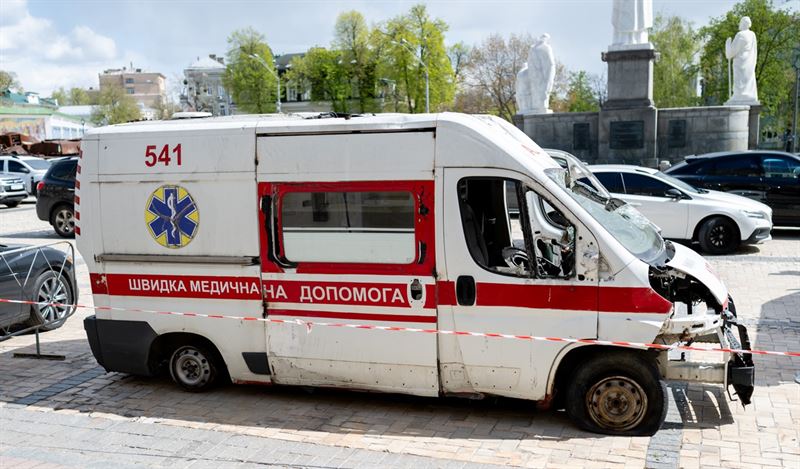
During 1,534 days of war, Ukraine’s health-care system has experienced repeated attacks. WHO has verified more than 3,000 attacks on health care over this period through its Surveillance System for Attacks on Health Care (SSA), applying global verification standards and systematically monitoring, verifying and reporting incidents.
The scale and frequency of these incidents place patients and health workers at constant risk and undermine the delivery of life-saving services. Under international humanitarian law (IHL), the wounded and sick, medical personnel, healthcare facilities and transport must be respected and protected. Member States must also take feasible precautions to protect civilians and civilian objects, including healthcare services, and to facilitate the rapid and unimpeded passage of humanitarian relief for civilians in need, subject to applicable controls.
From primary health care centres to maternity hospitals, and from ambulance teams to pharmaceutical warehouses, every component of the system has been affected. Healthcare facilities have been most impacted: around 80% of verified attacks have affected outpatient clinics, hospitals and other care settings. Beyond the immediate casualties, such attacks disrupt service delivery, damage critical infrastructure, and erode the health system’s capacity over time.
“Every one of these attacks is a violation of international humanitarian law, and every one represents a patient who couldn’t be reached, a health worker in danger, a community left without care,” said Dr Hans Henri P. Kluge, WHO Regional Director for Europe. “This cannot be normalised. Under international humanitarian law, healthcare is protected. That is not a guideline or a recommendation. It is a binding obligation on all parties to any conflict. WHO will continue to document every attack on health and advocate for the protection of health workers in Ukraine.”
Healthcare transport remains among the most vulnerable elements of the system in terms of human impact. Approximately 20% of recorded attacks have been on ambulances and other health vehicles, with nearly one in three of these incidents resulting in casualties—making medical transport one of the highest-risk areas for injury and loss of life.
“Since the beginning of this year alone, 186 attacks on health care verified by WHO have resulted in 15 deaths and left at least 81 people injured, with numbers continuing to rise. Compared to the same period in 2025, the number of deaths has increased nearly fourfold, while injuries have almost doubled. These patterns not only place health workers at heightened risk, but also further disrupt the continuity of care for those who depend on it most,” said Dr Jarno Habicht, WHO Representative in Ukraine.
“WHO Surveillance System for Attacks on Health Care (SSA) monitors and verifies the impact of attacks on healthcare to inform system-wide advocacy for compliance with international humanitarian law (IHL) and the protection of healthcare, in line with UN Security Council Resolution 2286 (2016) and World Health Assembly Resolution 65.20 (2012), which condemn attacks on health workers and facilities and call for measures to prevent violence and ensure accountability,” added Dr Habicht.
Escalating health needs in Ukraine
The continued damage to health infrastructure has significantly constrained the ability of medical personnel to deliver essential care, requiring constant adaptation of humanitarian health operations. This is unfolding amid escalating needs: according to the United Nations, 12.7 million people in Ukraine require humanitarian assistance, including 9.2 million in need of health support. Civilian casualties have increased by an estimated 31% compared with the previous year, 2025.
According to the latest estimates, the needs for rebuilding the healthcare sector over the next 10 years already amount to USD 23.6 billion. At the same time, we are doing everything possible to ensure that patients have access to necessary medical care. We are grateful to WHO and all our partners for their systematic support, which helps sustain and strengthen the healthcare system under these extremely challenging conditions,” said Viktor Liashko, Minister of Health of Ukraine.
Long-term, sustained support to Ukraine’s health system
Despite continued attacks and mounting humanitarian needs, sustaining and strengthening Ukraine’s health system remains essential to safeguarding uninterrupted access to life-saving services for millions of people.
In Ukraine last year alone, WHO supported:
- 1.9 million people with essential health services
- Nearly 1,000 health facilities with medicines and equipment
- More than 2,500 health workers through training
- Over 6,400 patients through medical evacuation abroad for specialist care.
In close coordination with the Ministry of Health, local authorities and partners, WHO continues to adapt support to the evolving situation, helping facilities stay functional, protecting health workers where possible, and reinforcing the resilience of the health system.
WHO has been on the ground in Ukraine since 1994, supporting the country’s health system. Our efforts strengthen the immediate humanitarian response, recovery, restore essential services disrupted by war, and advance institutional reforms that will shape Ukraine’s health system for decades, ensuring better access to care and improved population health.
eupress@who.int