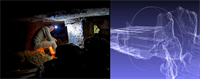
Etruscan Chamber Tombs Made Accessible in Digital Portal
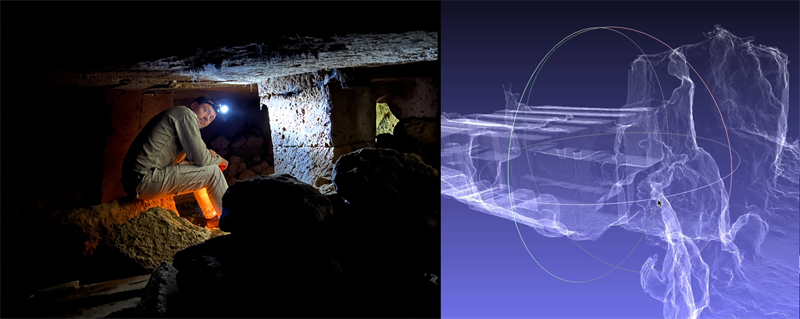
Imagine stepping into a 2,500-year-old tomb – without ever leaving your sofa. Using advanced digital technology, Swedish researchers have documented and visualized nearly 280 Etruscan chamber tombs in Italy. The result is a new digital portal that opens up this cultural heritage to scholars, students, and the public worldwide.
“We are never the first to visit these places – they have been used by shepherds and farmers and recorded by archaeologists for more than a hundred years. Yet it sometimes feels as if time has stood still, and that we are intruding on a lasting silence,” says Jonathan Westin, research engineer at the University of Gothenburg.
Westin has himself squeezed through narrow openings and crawled along dark passageways to document several tombs around San Giovenale in Italy.
The portal, already open to visitors, brings together earlier research from the Swedish Institute in Rome and combines it with new digital documentation made possible by recent technological advances.
“Plumb bobs, measuring tapes, and field notes now share space with photogrammetry, laser scanning, and databases,” Westin explains.
With this combined material, he and colleagues at the University of Gothenburg’s research infrastructure for digital humanities have built a digital model and an interface where each tomb can be explored.
A Virtual Experience
The project has also produced a Virtual Reality application designed to give users a more embodied sense of the tombs.
“Above all, the 3D scans allow people who have never been able to travel to these sites or descend into the chambers to both experience them and extract new data for the first time,” says Westin.
In reality, the tombs are often difficult to access. They are located far from public roads and often require crawling through collapsed passages and thick dust.
“Quite often you have to wriggle through debris in what, to an untrained eye, might just look like a cave. The air is heavy with dust, and you are acutely aware of how far away help would be if anything were to happen.”
The Swedish Institute in Rome, which runs the project together with the University of Gothenburg, has played a central role in Swedish archaeology in Italy since 1925. The institute was heavily involved in the major excavations in southern Etruria in the 1950s. Today, its library is one of the world’s leading resources in Etruscology, visited by scholars from across the globe.
“The excavations gained significant media attention, both in Sweden and in Italy, thanks in large part to King Gustav VI Adolf’s involvement. The king, himself an archaeologist with a deep passion for ancient cultures, personally participated in the excavations up until the year before his death in 1973,” says Hampus Olsson, senior lecturer at the Swedish Institute in Rome.
He and the other project members now hope that the digital database will continue to grow and become a resource for even more Swedish, Italian, and international projects.
Contact:
Jonathan Westin, Phone: +46 73 040 1770, E-mail: jonathan.westin@lir.gu.se
Hampus Olsson, Phone: +46 70-353 8480, E-mail: olsson@isvroma.org
Visit the portal: https://etruscan.dh.gu.se/
Hanna Erlingson
Communications officer, University of Gothenburg
Phone: +46 76 618 5317
E-mail: hanna.erlingson@gu.se
University of Gothenburg is one of the major universities in Europe, with about 58 000 students and a staff of 6 800. Its seven faculties offer training in the Creative Arts, Social Sciences, Natural Sciences, Humanities, Education, Information Technology, Business, Economics and Law, and Health Sciences. The University’s unique breadth in education and research provides an interdisciplinary environment conducive to collaboration with private enterprise and public institutions. The quality of the University has earned recognition in the form of numerous awards, including a Nobel Prize, and a steady stream of applicants at all levels.