
AI and Gaming: How It’s Really Being Used — Insights from BETON’s COO, Dmytro Taran
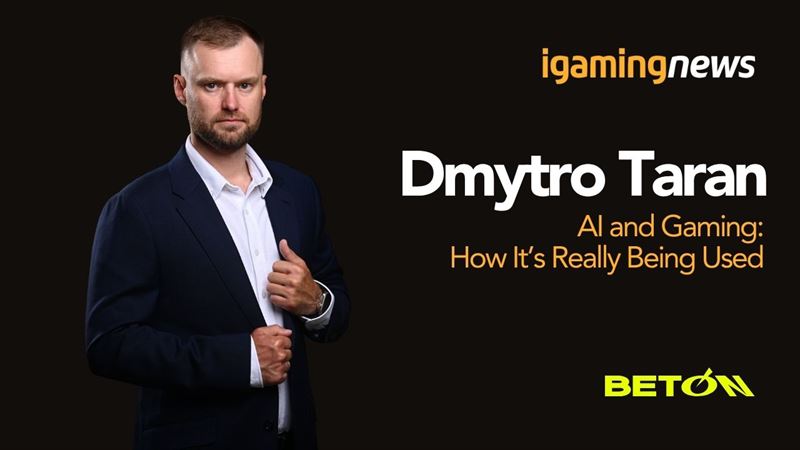
As AI continues to dominate conversations across the iGaming industry, separating genuine innovation from hype has never been more important. Few operators are better positioned to speak on this than BETON, a fully licensed Ukrainian casino and sportsbook known for its transparent operating model, advanced responsible gaming focus and strong ties to supporting sport at both local and national levels.
Operating in a fast-evolving and uniquely challenging market, BETON has taken a pragmatic approach to technology, prioritising real-world impact over buzzwords. From operational efficiency to player protection, AI is already shaping how modern operators think and act.
We sat down with BETON’s COO, Dmytro Taran, to explore how AI is actually being used today, where it’s delivering measurable values and what the future holds for operators looking to adopt it in a meaningful way.
AI is one of the most talked-about trends in iGaming. Where is it genuinely delivering value today and where is the industry overhyping its potential?
DT: AI is already delivering tangible value in several core operational areas. Fraud detection and risk management are among the most mature use cases, where machine learning models can identify anomalies, prevent abuse and improve overall platform security. Similarly, CRM and retention strategies have been significantly enhanced through better segmentation and more precise timing of player communications, ultimately improving lifetime value.
Marketing is another area seeing real gains. AI is accelerating creative production, enabling faster generation of banners, copy and campaign concepts, while also allowing teams to scale A/B testing and optimise performance more efficiently. Customer support has also benefited, with AI handling first-line queries and improving response times. In the VIP segment, AI helps identify high-value players earlier and ensures that engagement efforts are prioritised effectively.
Where the industry tends to overhype AI is in positioning it as a replacement for strong product thinking or engineering expertise. AI is a powerful tool, but it cannot compensate for weak fundamentals. Likewise, the idea of “magic personalisation” is often overstated—without high-quality data and clear strategy, AI-driven personalisation will fall short of expectations.
From an operational standpoint, how is BETON currently using AI to improve areas like trading, risk management, or customer support?
DT: At BETON, AI is embedded across several operational functions. In risk and payments, it is used for transaction scoring and identifying patterns associated with bonus abuse. This allows the business to act proactively and minimise financial exposure.
CRM has become a key performance driver, particularly in an environment where acquisition can be volatile. AI supports lifecycle segmentation and value-based targeting, enabling more effective communication strategies. In marketing, it is used to generate creative assets, test hypotheses rapidly and optimise funnels in real time.
The VIP segment is another area of focus, where AI helps identify potential high-value players early in their journey. This allows for more tailored engagement and efficient allocation of VIP management resources.
Customer support has also been enhanced through automation of standard queries and the use of AI-powered tools that assist agents in resolving more complex issues quickly and accurately.
Can you share a practical example where AI has made a measurable impact on efficiency or cost reduction within your business?
DT: One of the most impactful applications has been AI-driven CRM segmentation. By improving how players are grouped and targeted, BETON has seen stronger conversion into second deposits, alongside measurable improvements in retention and average revenue per user.
In the VIP segment, better identification and prioritisation of high-value players has led to increased deposits and higher gross gaming revenue. Marketing efficiency has also improved significantly. Faster creative production has enabled more testing, which in turn has driven better return on marketing investment.
Overall, these improvements have helped offset challenges in acquisition by strengthening retention and growing the VIP segment, resulting in a more balanced and efficient commercial model.
Personalisation is often highlighted as a key benefit of AI. How are you using it to enhance the player experience without crossing into over-targeting?
DT: The guiding principle is relevance over pressure. Personalisation should enhance the player experience, not overwhelm it.
BETON focuses on behaviour-based segmentation rather than purely value-based targeting. Communication frequency is carefully controlled, with an emphasis on delivering the right message at the right time rather than increasing volume. Transparency is also key, particularly when it comes to bonus mechanics and promotional offers.
Over-targeting is a real risk. If players feel bombarded or pressured, it can lead to fatigue and ultimately reduce lifetime value. The goal is to create a balanced, engaging experience that respects player preferences.
BETON places strong emphasis on responsible gaming — how is AI helping you better identify and support at-risk players?
DT: AI plays a critical role in early detection of risk signals. This includes monitoring changes in deposit behaviour, identifying unusual activity patterns and recognising deviations from typical player behaviour.
When risk indicators are detected, automated systems can trigger interventions such as setting limits, sending notifications, or prompting cooling-off periods. More complex cases are escalated for manual review, ensuring that human oversight remains part of the process.
This combination of automation and human judgment allows for more timely and effective player protection measures.
Do you believe AI can genuinely make gambling safer, or are there limitations the industry needs to recognise?
DT: AI can absolutely contribute to making gambling safer, but it is not a standalone solution. Its effectiveness depends on how it is implemented and the priorities of the business using it.
There are inherent limitations. Models can produce inaccuracies, and player behaviour evolves quickly, meaning they must be continuously updated to remain effective.
Ultimately, AI should be seen as a tool that supports responsible gaming strategies, rather than replacing them.
Integrating AI into existing systems can be challenging. What obstacles have you encountered and how have you addressed them?
DT: One of the biggest challenges is data quality and fragmentation. Without consistent and reliable data, AI models cannot perform effectively. Integration into existing systems can also be complex, particularly when balancing the need for speed with maintaining quality.
A lack of in-house expertise can further slow down adoption. To address these challenges, BETON has focused on standardising processes and services, implementing AI incrementally rather than all at once and maintaining a strong focus on return on investment rather than following industry trends.
Looking ahead, which AI applications do you believe will have the biggest impact on iGaming over the next few years?
DT: The most significant impact is likely to come from AI-driven marketing, particularly in creative generation and automated testing. Real-time CRM systems that trigger communications based on player behaviour will also become increasingly important.
VIP lifecycle management is another key area, with AI enabling earlier identification and more precise engagement strategies. More broadly, we expect to see greater automation across the entire customer lifecycle, improving both efficiency and scalability.
In simple terms, what does “using AI properly” in iGaming look like in 2026?
DT: Using AI properly means embedding it into core business processes rather than treating it as an add-on. This requires high-quality data, clear performance metrics such as ROMI, LTV and retention and a strong focus on measurable outcomes.
At its core, AI should be used to improve efficiency, enable scalability and strengthen risk control. It is not about innovation for its own sake, but about building a more effective, sustainable and well-managed business grounded in the principles of Responsible Gaming.