
Roundtable: The Italian iGaming Reset (2025/2026)
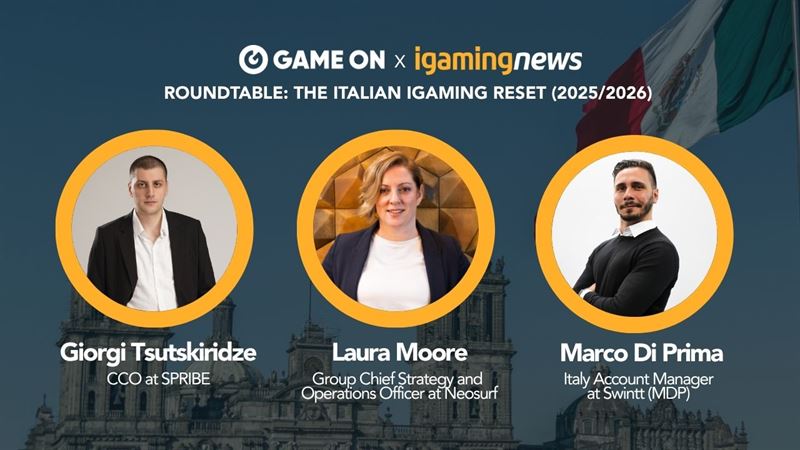
In this roundtable, Laura Moore, Group Chief Strategy and Operations Officer at Neosurf (LM), Giorgi Tsutskiridze, CCO at SPRIBE (GT), and Marco Di Prima, Italy Account Manager at Swintt (MDP), explore what this reset means in practice.
Italy’s iGaming market is entering a defining new phase. Framed by regulators as a “decisive reset,” the latest licensing overhaul is raising the bar on compliance, transparency and long-term sustainability, reshaping the competitive landscape in the process.
In this roundtable, Laura Moore, Group Chief Strategy and Operations Officer at Neosurf (LM), Giorgi Tsutskiridze, CCO at SPRIBE (GT), and Marco Di Prima, Italy Account Manager at Swintt (MDP), explore what this reset means in practice: from stricter player protection and evolving payment dynamics to market consolidation, mobile-first behaviour and new growth opportunities. As the dust begins to settle, one question remains: who is best positioned to thrive in Italy’s new era?
With the ADM describing its new licensing regime as a “smooth and decisive reset” of the country’s previous multi-domain model, how do you envision the changes affecting the market in 2026? What are some of the new regulations operators, suppliers and payment providers will all need to be aware of if they wish to remain both competitive and compliant?
LM: For a dedicated payment provider like Neosurf, this 'decisive reset' isn't a hurdle—it’s a significant positive opportunity to demonstrate our value as a strategic growth partner. The move toward a more 'industrialised' market essentially clears the field of low-quality friction and elevates providers who prioritise transparency. The most critical shift for the industry is the dramatic tightening of the PVR (Punti Vendita Ricarica) framework. The regulator is moving away from the era of anonymous cash deposits toward a system of 'verified liquidity.' This plays directly into Neosurf’s strengths. By 2026, compliance will be the primary competitive advantage; operators who leverage our Rapido Cash solution will find themselves ahead of the curve, as we have already built the bridge between traditional cash habits and the new, fully traceable, Sports Betting Protocol 5.0-compliant ecosystem.
GT: Italy’s regulatory reset signals a shift toward a more structured, transparent, and sustainable market. In 2026, we expect consolidation among operators, higher entry standards, and a stronger emphasis on long-term compliance over short-term acquisition tactics. For operators, suppliers, and payment providers, competitiveness will increasingly depend on regulatory readiness - particularly around technical certification, data reporting, and responsible gaming integration. While stricter rules may initially slow expansion, they ultimately create a healthier ecosystem where trusted brands can thrive. For suppliers like us, a clearer framework allows for more efficient integrations and long-term planning, ensuring that innovation aligns with compliance from day one.
MDP: Italy’s new licensing framework is clearly aimed at creating a more controlled and sustainable market. From our perspective, the biggest change is the move towards a more structured and transparent regulatory environment, which should ultimately benefit both operators and suppliers.
For companies that are prepared to operate within a regulated ecosystem, this creates stability and long-term opportunities. However, it also raises the bar in terms of compliance, technical certification, and responsible gaming standards. Operators and suppliers will need to be very aligned with ADM requirements around player protection, reporting and game approvals.
At Swintt, we see this as a positive step because a clearer regulatory framework allows suppliers to focus on delivering high quality certified content that meets the expectations of both regulators and operators.
In 2026, I expect we’ll see a slightly more consolidated market, with fewer but stronger operators who are willing to invest in compliance and quality content. For suppliers like Swintt, it means continuing to deliver games that perform well in regulated environments while supporting operators with reliable and compliant content.
Italy’s new framework has a strong emphasis on player protection and will enforce much tighter standards for operators in terms of self-exclusion mechanisms, spending limits and account verification. In what ways will your companies look to collaborate with operators to help them adhere to these requirements and what data insights will you be able to provide?
LM: The 'Identity-Cash Paradox' is at the heart of this question. How do you enforce the mandatory identity verification structure brought about by the Sistema Pubblico di Identità Digitale (SPID)’s electronic identity cards without losing the 'pick-up-and-play' nature of the retail cash player? Neosurf’s role is to act as the 'Invisible Gatekeeper' here. Our technology allows for real-time verification at the point of deposit with our Full-Circle KYC, ensuring the operator’s customer is the same customer depositing cash to their account. Our data insights for this compliance handshake provide a sophisticated view of customer behaviour across this hybrid 'Phygital' channel—bridging the gap between physical retail touchpoints and digital play to ensure a holistic view of the player journey.
GT: The new Italian framework reflects a broader global trend toward responsible, data-driven gaming environments. Our approach is to support operators with tools and insights that help them meet these requirements seamlessly rather than treating compliance as a separate process. Through advanced analytics, real-time behavioural monitoring, and customizable engagement features, we enable operators to identify risk signals early and respond proactively. We also provide detailed performance and interaction data that helps partners understand player behaviour patterns while maintaining privacy and regulatory standards. Ultimately, compliance and player protection should enhance user experience, not restrict it, and our role is to ensure operators can achieve both simultaneously.
MDP: Player protection has become a central pillar of modern regulation, and Italy is taking this very seriously. As a supplier, our role is to support operators by ensuring that our content is fully compliant and designed with responsible gaming principles in mind.
At Swintt, all of our games are developed to integrate seamlessly with operator tools such as self exclusion systems, spending limits and player verification frameworks required by ADM. Ensuring that our content works smoothly within these systems is an important part of supporting our partners.
Beyond compliance, we also provide operators with performance insights on how games behave across different markets and player segments. This helps them better understand engagement patterns while ensuring that player safety mechanisms remain fully respected. Responsible gaming and entertainment should go hand in hand, and that’s something we take very seriously at Swintt.
An interesting bi-product of the new regulations is that several established international operators have now chosen to leave the market. Has this effectively opened the door for new operators to capitalise and – if so – what can your respective companies bring to the table in terms of helping them acquire and retain players while boosting their market share?
LM: Neosurf and Rapido Cash are perfectly positioned to support both established incumbents and ambitious new entrants in this new era of the Italian market. Our priority is ensuring that operators have the tools they need to win the customer over immediately by offering their preferred payment method in a way that the customers find easy to onboard and is 100% compliant. Our solution is designed for speed; it’s simple to integrate and provides an instant 'Trust Network' that bridges the gap to the local Italian 'tobacco shop' culture. By making the payment process easy and familiar, we help operators acquire and retain players more effectively, allowing them to scale their market share while we handle the complexities of the new rigorous AML standards and the 'Phygital' player journey.
GT: When established operators leave a regulated market, it naturally creates space for new entrants - but success is never guaranteed. New operators must differentiate quickly, build trust, and demonstrate reliability to both regulators and players. This is where experienced suppliers play a crucial role. We help partners accelerate market entry with proven, scalable products, strong technical infrastructure, and high-engagement content that is already recognized globally. Beyond acquisition, retention becomes the real battleground, and that’s driven by player experience, stability, and entertainment value. Our focus is on equipping operators with solutions that strengthen loyalty, extend session engagement, and support sustainable growth rather than short-term spikes.
MDP: Whenever regulatory frameworks evolve, it’s normal to see some operators reconsider their position in the market. At the same time, these changes can create opportunities for new or expanding brands that are ready to invest in Italy for the long term.
For suppliers like Swintt, this creates an opportunity to support both established operators and new entrants with content that stands out in a competitive environment. The Italian market is extremely mature and players have very clear expectations when it comes to quality and entertainment value.
By offering a diverse portfolio with strong themes, proven mechanics and regular new releases, we help operators keep their offering fresh and engaging. At Swintt, we see content variety as a key driver for both player acquisition and retention.
Market research indicates player preferences in Italy are steadily shifting towards mobile gaming, with almost 70% of customers preferring to access platforms on their smartphone or tablet device. In light of these statistics, how are your games, services or products set up to accommodate mobile users and do you expect that this percentage will continue to grow?
LM: We fully expect the mobile preference for Rapido Cash customers to exceed the market average of 70%. The Rapido Cash journey is naturally mobile-first; a customer simply pulls up their deposit barcode on their phone, grabs their ID and cash, and heads to their local store. Because the smartphone is the primary way players carry their barcode, Rapido Cash is the ultimate 'Phygital' tool. We don't just see mobile as a trend; it’s the essential bridge that allows our customers to transition from a physical cash transaction to a digital gaming experience in seconds.
GT: Mobile preference is no longer a trend - it’s the dominant access channel, and we expect the share to continue rising as devices, networks, and user expectations evolve. Our products are built mobile-first, not adapted later, which means performance, interface design, and gameplay flow are optimised for smaller screens and touch interaction from the start. This ensures consistent speed, responsiveness, and visual clarity across devices. Mobile users also tend to value immediacy and seamless functionality, so lightweight architecture and rapid loading are essential. As mobile usage grows, suppliers who prioritise mobile performance at the core of product design will be best positioned to support operators competing in markets like Italy.
MDP: The shift towards mobile is something we’re seeing across almost every regulated market and Italy is no exception. Today, the majority of players expect a seamless mobile experience, whether they’re playing on smartphones or tablets.
At Swintt, our games are developed with a mobile first approach, ensuring that gameplay, graphics and performance are fully optimised for smaller screens without compromising quality. This allows operators to offer players the same high quality experience regardless of the device they are using.
Looking ahead, I expect the mobile share to continue growing. Convenience plays a huge role in how players interact with casino content today, and mobile platforms naturally fit into that lifestyle.
In terms of emerging consumer trends, are there any areas in the new-look Italian market that you feel are currently being under-serviced? Whether its introducing digital wallets that offer fast and secure payments, providing mobile-first slots with innovative features or exploring relatively virgin sectors like esports, where do you see the big opportunities lying?
LM: The biggest opportunity lies in evolving the cash player's digital experience without losing the core values of the cash-based player. Through Rapido Cash, Neosurf is bringing its extensive international experience from other regulated markets to support this emerging trend. We see an underserved need for Responsible Gaming in Digital Wallets—systems that allow players to use cash to fund their digital play, while also utilising advanced responsible gambling features like user-defined self-limits and spending 'cool-off' periods. Furthermore, we see significant potential in sectors like esports, where younger, tech-savvy audiences require better 'micro-liquidity' through fast, secure, and compliant cash-to-digital pathways that fit their specific spending habits.
GT: One of the most promising opportunities lies in experiences that combine simplicity with high engagement. Italian players increasingly gravitate toward entertainment formats that are easy to understand but deliver dynamic interaction. There is also significant potential in innovation around payments, personalisation, and real-time engagement features that enhance player control and transparency. Markets that tighten regulation often reward providers that can balance compliance with creativity, and we believe there is room for formats that offer both. Additionally, emerging verticals and hybrid entertainment models could see strong adoption as operators look for ways to differentiate in a more competitive and structured environment.
MDP: Despite being one of Europe’s most established gaming markets, Italy still offers interesting opportunities for innovation. One area that continues to evolve is the development of more engaging game mechanics and features that keep players entertained while remaining compliant with local regulations.
At Swintt, we’ve seen strong engagement from Italian players when games combine familiar mechanics with fresh features and strong visual themes. This balance between innovation and familiarity is particularly important in mature markets like Italy.
Another opportunity lies in personalisation and localised content. Italian players have strong preferences when it comes to themes, gameplay styles, and entertainment value, so suppliers that understand the local audience can create experiences that resonate more strongly.
What role to you think local partnerships will play for businesses looking to establish themselves in Italy going forward? From collaborating with regional payment providers to forming commercial partnerships and releasing branded content, how necessary will having these relationships in place be in terms of building trust and credibility within the market?
LM: In Italy, trust is local. A digital-only presence isn't enough to build credibility; you need to be where the player lives. Local partnerships are the only way to navigate the 'Dignity Decree' advertising ban. If operators can’t show a TV ad, the 'ad' is the physical presence of the payment partner in tens of thousands or retail locations. Neosurf’s Rapido Cash provides that physical presence. For a brand looking to establish itself, being associated with a known, compliant, and ubiquitous local payment method is by far the most effective form of 'silent marketing' permitted under the current Italian laws.
GT: Local partnerships will be fundamental for any company looking to succeed in Italy. Regulation, culture, and consumer expectations all vary significantly from market to market, and local expertise helps bridge those gaps quickly. Collaborating with regional payment providers, media partners, and technology specialists allows international brands to localise effectively while maintaining global standards. These relationships also build credibility with regulators and players, which is essential in a market that prioritizes trust and transparency. In our experience, the strongest market entries happen when global scale is combined with local insight - that combination enables faster adaptation, stronger compliance, and ultimately more sustainable growth.
MDP: Local partnerships are extremely important for any company looking to establish itself in the Italian market. Italy has a unique regulatory structure and a very specific player culture, so working closely with local operators and partners helps suppliers navigate both effectively.
For Swintt, building strong relationships with Italian operators has been an important part of establishing our presence in the market. These partnerships allow us to better understand player preferences and support operators with content that fits their audience.
In a market as competitive as Italy, trust and long-term partnerships can make a real difference. Companies that invest in these relationships are usually the ones that succeed in building sustainable growth.