
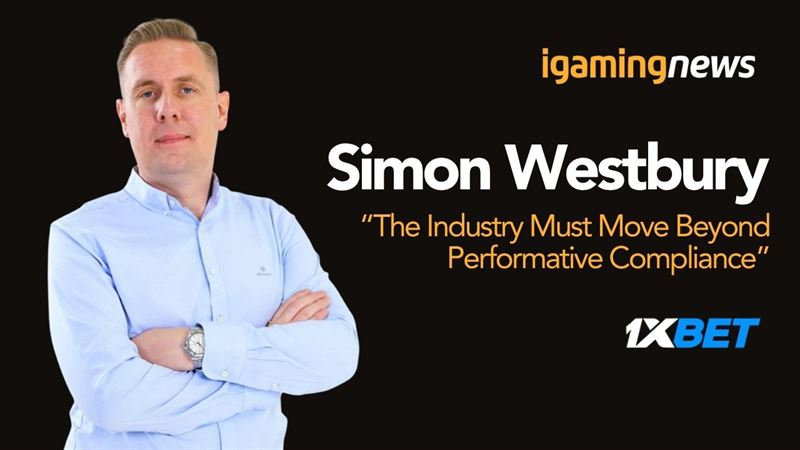
Simon Westbury of 1xBet: “The Industry Must Move Beyond Performative Compliance”
As the global gambling industry continues to come under increasing scrutiny around player protection, regulation and long-term sustainability, the conversation is evolving beyond compliance alone and into questions of culture, product design and genuine responsibility.
At the centre of that debate is 1xBet, one of the industry’s most recognisable global operators, as it continues to refine its approach to balancing commercial growth with safer play. With more than 35 local licences, a growing portfolio of major sports partnerships and a sharpened focus on regulatory alignment and player wellbeing, the business is positioning itself at the heart of what modern responsible gambling should look like in practice, not just in theory.
Simon Westbury sat down with our Editor, Abigail Welch, to reflect on his first year as Strategic Advisor to 1xBet and the broader shifts taking place within the industry. In this wide-ranging interview, he explores internal transformation at the operator, the ongoing tension between profitability and player protection and where the industry is still falling short.
What emerges is a clear message: the future of the sector will be defined not by those who simply meet regulatory requirements, but by those who embed player protection into the very foundations of their business.
You’re nearing your first anniversary as Strategic Advisor to 1xBet. Over that period, what’s been the most meaningful internal shift in how the business balances commercial growth with player protection?
That decision was made internally before I joined. Over the last year, what we’ve really seen is the team’s commitment to maintaining that direction, which is what ultimately got me involved.
That approach has been built around three key pillars. First, a strong regulatory focus, including an increase in licences. Over the past year we’ve grown to more than 35 local licences.
Second, there’s been a clear focus on partnerships: who we work with, how we work with them and ensuring we maintain the highest possible standards. If we’re being honest, in the past there were cases where people were able to work with us in ways they shouldn’t have, and that created issues which have been well documented.
Third, it’s about empowerment internally. I think the industry can perhaps see me as an example of how 1xBet has empowered individuals to go out, represent the company and make sure its story is heard.
Following your recent panel, “Responsible Gaming or Revenue Gaming,” where do you think the industry still gets it wrong when trying to align profitability with genuine player safety?
Well, I touched on this during the panel. I think there’s still a lot of what I’d call performative compliance and tick-box exercises, rather than a genuine commitment to player safety.
That also extends from suppliers to operators. When a game is being designed, for example, is player safety truly at the forefront, or is the primary focus simply on revenue? That’s a difficult but important question for the industry to ask itself.
There’s been a lot of discussion around positive play, but we also need to consider player literacy. Do players actually understand what RNG means, what RTP is, or how odds are set? I used an example on the panel about taking some former colleagues to a casino to play blackjack. Some of them had never been in a casino before and didn’t understand how the game worked. If we operate in this industry, we need to recognise that not every customer fully understands the products they’re engaging with.
Personally, I don’t really talk about “positive play”; I talk about safe play. Looking at some of the research we’ve carried out with SBC — including an upcoming report I’ve previewed — 69% of respondents said players who gamble safely over the long term are ultimately more profitable customers. Meanwhile, 84% believed player education is the foundation of safety, yet 49% said commercial considerations still act as a barrier to player protection. We can’t continue operating in that space.
I also think regulation plays a major role. In some regions, player safety is largely left to operators rather than being firmly embedded in regulation, and that creates challenges. Sometimes this industry needs clear boundaries and direction, because otherwise we tend to drift too close to the line of what’s acceptable.
The key is balance. During COVID, for example, the UK took a measured approach to gambling advertising, whereas Spain introduced far stricter restrictions and has since heavily limited gambling advertising altogether.
Ultimately, the bigger question is whether player safety is genuinely built into every stage of the industry — from game design and UI/UX through to mathematical models and sportsbook algorithms — or whether it’s still being treated as an add-on. Too often, player protection is viewed as something secondary, rather than something intrinsic to the way products are created and operated.”
The ‘International Player Safety Index’ has highlighted cultural differences in player behaviour. Are regulators too focused on creating universal frameworks, rather than market-specific approaches?
I’m actually going to defend regulators a little here, because people often forget that regulators can only enforce what governments instruct them to enforce. At the core of the issue is how governments currently view the gambling industry — often as both a major source of tax revenue and, at the same time, as a problematic sector. Until that wider societal perception changes, in the same way attitudes towards smoking or drinking have evolved over time, the industry will continue to face challenges.
Regulators are frequently asked to implement major changes at very short notice. Hypothetically, if a government decided to introduce gambling advertising restrictions a month before a World Cup, regulators would then have to work out how to implement and enforce that in real time. That’s not always straightforward.
There are also clear cultural differences across markets. The reports showed, for example, that in parts of Africa there is significant concern around gambling being viewed as a form of income generation. Some markets in LatAm shared similar attitudes, with around 50% of respondents reflecting that view.
At the same time, LatAm stood out positively in its adoption of technology. Around 69% of respondents said they were using real-time activity monitoring, while 34% were already using AI tools — higher than any other region surveyed. Interestingly, 84% of operators in LatAm were also carrying out KYC procedures, compared to 75% in Africa and 74% in Europe.
Europe is often seen as the benchmark for advanced regulation, but the findings showed that 43% of respondents were dissatisfied with the current regulatory landscape there, while 26% wanted greater clarity. That point around clarity is especially important. In Portugal, for example, operators face restrictions around when and how they can intervene if they identify problematic behaviour. In the UK, operators have often been cautious because they don’t want to fall foul of the UKGC, while in Sweden many waited to see how enforcement would develop before taking action.
What this highlights is the need for stronger communication between operators, regulators and society more broadly. There needs to be consistency in how we define player protection and how it is embedded within regulation, but there also needs to be clarity around how those rules are applied.
That said, it can’t be a one-size-fits-all approach. Brazil is different from the UK, and the UK is different from Nigeria. The principles of player protection may be universal, but the way they are implemented has to remain culturally relevant to each market and audience.
Data is one thing, execution is another. How is 1xBet translating these research insights into tangible product or policy changes that players can actually feel?
I don’t think this is something we can tackle alone. But one thing we have committed to is taking meaningful action. We’re slightly early in discussing it — unfortunately bureaucracy has got in the way of me giving you the exclusive I’d hoped to share during this interview — but there is a major announcement coming in the next couple of weeks that will demonstrate 1xBet’s commitment in this area.
The research reports we’ve conducted across Africa, LatAm and Western Europe — along with the next report that’s due to be released — have helped create a broader framework for understanding where the industry currently stands and where improvements are needed.
As a result, we’re launching what I’d describe as a dedicated body focused on research, education and wellbeing. We’ll be investing heavily in those three pillars to help ensure player protection is placed at the forefront not only of what 1xBet does, but also as a wider discussion point for the industry as a whole.
As major sporting events like the FIFA World Cup approach, do you think operators are prepared for the surge in casual bettors—or are we underestimating the risks tied to short-term engagement spikes?
Look, as an operator you naturally get excited about a World Cup — and so does the world. It’s unscripted, dramatic and emotional, and that unpredictability is exactly what makes it so compelling, particularly for fans.
Are operators ready for it? Of course, we’ll be ready, but there will always be challenges to manage. That comes back to the commitment operators have to maintaining a safe environment throughout major sporting events like this.
There is also an element of personal responsibility for those who choose to gamble, but that links directly to education and literacy. The industry needs to do more to ensure players understand what they are engaging with.
We know the tools exist — deposit limits, loss limits, self-exclusion, and time-outs are among the most effective measures available. But for casual players, especially those entering the market during a World Cup, the question is whether they fully understand and engage with those tools. In many cases, they don’t.
We’ve all seen it — someone in a pub putting £1 on to try to win a million. In reality, the odds are extremely long, but without an understanding of how odds work, that context is often lost.
So the key challenge during events like the World Cup is ensuring that casual bettors are supported with the right education and safeguards, so they can still enjoy the experience. Ultimately, it’s on us as an industry to make sure that engagement remains safe, responsible and enjoyable throughout the tournament.
There’s increasing discussion around affordability checks and friction in the user journey. How do you strike the right balance between safeguarding players and maintaining a competitive, engaging product?
Well, there were some recent comments from the Safer Gambling Forum in Leeds where the UKGC indicated they’re not asking for things like payslips. But that does raise the question: how do you effectively carry out affordability checks without looking at a customer’s financial position in some form?
The reality is that the detail matters. We don’t want to make the process overly clinical or intrusive, because no one enjoys that kind of experience — whether it’s going to the doctor or the dentist. Player protection needs to be effective, but also as seamless and unintrusive as possible. It shouldn’t feel punitive.
Ideally, it becomes part of the entire player journey — from registration through to deposits and ongoing activity — rather than something that feels like a sudden intervention. If players are made to feel like they’ve already got a problem, or might have one, they tend to disengage entirely. So the challenge is integrating protection in a way that feels natural and consistent.
There’s also a broader commercial and structural layer to this. 1xBet, for example, has a strategy built on 18 years of experience, combining localised products with digital acquisition tools and sponsorship opportunities where permitted. We’ve seen that across major partnerships in sport, from FC Barcelona and Paris Saint-Germain through to FIBA and other global organisations.
These sponsorships help build brand trust with players. However, in some newly regulated markets, there is now discussion around restricting or even banning sponsorship and marketing. The unintended consequence of that is it can strengthen the offshore market, where players are being encouraged — sometimes via influencers — to bet outside regulated environments because of perceived advantages like better odds.
That creates a challenge for the regulated space. While tax differences are inevitable, there does need to be a fair and workable framework that allows regulated operators to compete effectively and retain players within safer environments. Ultimately, it’s in everyone’s interest that customers remain within regulated markets rather than being pushed elsewhere.
I understand regulators and governments are often focused on tax generation, but regulation also needs to ensure commercial viability. If it isn’t commercially viable for operators, then the framework itself becomes less effective. So the balance between protection, competitiveness and sustainability is key.
Looking ahead 3–5 years, what will separate the operators who lead on player protection from those who simply comply—and where does 1xBet aim to position itself in that divide?
As I always say, the ‘one’ in our company name reflects our ambition to be number one in everything we do. And for me, that means every part of my working day is focused on positioning 1xBet as a leader — whether that’s in-market performance, brand perception, or player protection.
This is where I think the distinction between performative compliance and genuine commitment becomes really important. Operators who genuinely embed player protection and safer play into everything they do — from acquisition through to customer engagement and retention — are ultimately the ones who build stronger, more sustainable businesses. And, in reality, that long-term approach drives better commercial outcomes as well.
It might sound straightforward, but if you retain players in a responsible and sustainable way, you naturally build a more valuable customer base over time. People associate themselves with brands, and the responsibility on operators is to provide a safe, enjoyable environment that encourages that relationship in the right way.
That may mean going beyond the minimum regulatory requirements at times, and being more proactive rather than simply compliant. The focus shouldn’t just be on the letter of the regulation, but on embedding safer play into the full customer journey. That’s how you encourage longer-term engagement and trust.
There’s an old tortoise-and-hare analogy here. Too often, the industry has focused on short-term gains and “make as much as possible now, deal with regulation later.” But regulation is here to stay. So the better approach is consistency, patience and sustainability — building something that lasts.
Ultimately, gambling should be understood and accepted for what it is: a form of leisure and entertainment. The goal is to create an environment where people can enjoy that safely, without over-pathologising normal recreational play. I think the wider conversation needs to move towards that balance.
More 1xBet News: