

Neogap Therapeutics' PIOR technology identifies targets for personalised liver cancer immunotherapies
A new study published in the highly ranked scientific journal Gut examines how immune system T cells respond to tumours in patients with advanced liver cancer (HCC). Using Neogap Therapeutics' PIOR® software platform, the researchers have identified tumour-specific mutations, which may contribute to the development of personalised immunotherapies.
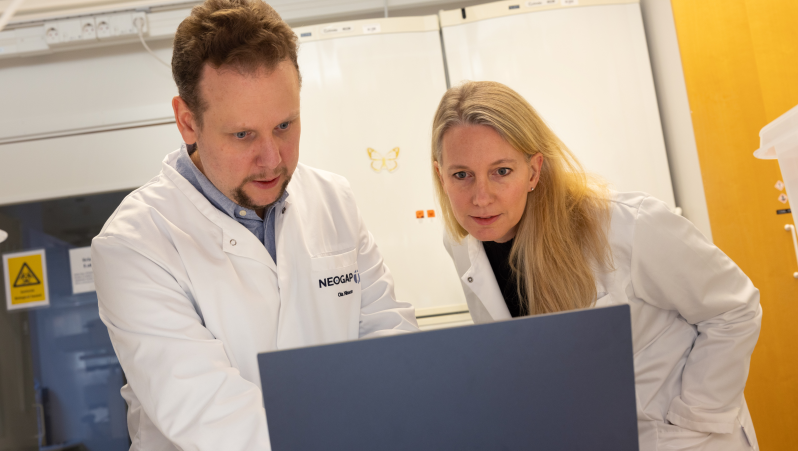
Ola Nilsson, co-author of the study, and Kristine Bylund in Neogap Therapeutics' lab. The study in Gut explores how tumour-specific neoantigens are identified and activate T cells for cancer treatment.
T cells are central to the body's defence against cancer but can also contribute to an immunosuppressive environment within the tumour. The study analysed T cells from the liver, lymph nodes, and tumour tissue to identify the most reactive cells to cancer-related neoantigens—tumour-specific proteins formed through mutations that can activate the immune system. Bioinformatic analysis identified 542 potential neoantigens from seven patients, 14 of which were found to induce a strong immune response, particularly in T cells from the liver and lymph nodes.
By using PIOR®, the researchers were able to identify neoantigens capable of activating T cells, which in turn can attack the tumour.
“The results demonstrate that PIOR® can effectively identify neoantigens with potential for future therapeutic applications,” says Associate Professor Anna Pasetto, a researcher at Karolinska Institutet and one of the lead authors of the study. “Data-driven analysis of neoantigens is an important component of the new generation of personalised cancer immunotherapies.”
The findings show that T cells from the liver and lymph nodes have properties that may be particularly suitable for future immunotherapies.
“This study aligns with Neogap's vision to develop the next generation of cell therapies,” says Ola Nilsson, Head of Neoantigen Production, Development & Clinical Processing at Neogap and co-author of the study. “PIOR® plays a key role in our efforts to identify the most promising neoantigens—an essential part of the development of future precision therapies.”
The study provides deeper insights into how T cells respond to neoantigens.
“Our findings reinforce the idea that T cells from lymph nodes may be particularly valuable as source material for generating reactive T cells—an approach already applied in Neogap's ongoing clinical trial in colorectal cancer, which specifically uses lymph nodes as starting material. These discoveries could have a significant impact on both research and the development of new treatments”, says Ola Nilsson.
The study, "Neoantigen-reactive T cells in hepatocellular carcinoma: identification, characterization and therapeutic implications", is published in the scientific journal Gut and can be accessed in full here: https://gut.bmj.com/content/early/2025/01/28/gutjnl-2024-334148

Project reference number: 190185439 – NEOpTTL. Funded by the European Union. Views and opinions expressed are however those of the author(s) only and do not necessarily reflect those of the European Union or EISMEA. Neither the European Union nor the granting authority can be held responsible for them.
For more information, please contact:
Samuel Svensson, CEO
Email: samuel.svensson@neogap.se
Phone: +46 733 54 21 94
About Neogap Therapeutics
Neogap Therapeutics is a Swedish clinical-stage biotechnology company focused on developing personalised cancer immunotherapy using the patient's own cells. The therapy is based on the company's two technologies PIOR® and EpiTCer®. PIOR® is sophisticated software that uses DNA sequencing data from the patient and machine learning algorithms to select tumour-specific mutations. Then, EpiTCer® is used to multiply T cells that can recognize and attack the selected tumor-specific targets. Neogap is located at Cancer Center Karolinska in Stockholm. To learn more about Neogap and its cutting-edge research, please visit the company's website at neogap.se and follow Neogap on LinkedIn.
Tags: