Global study: 97% of construction professionals expect demand for environmental product data to increase
A new report from One Click LCA highlights a growing gap between demand from architects and engineers (AEC) and manufacturers’ supply of Environmental Product Declarations (EPDs). 90% of AEC respondents say they prefer materials with EPDs. Yet, only 22% of manufacturers have EPDs for more than half of their portfolio, creating both a decarbonization challenge and a major commercial opportunity for both parties.
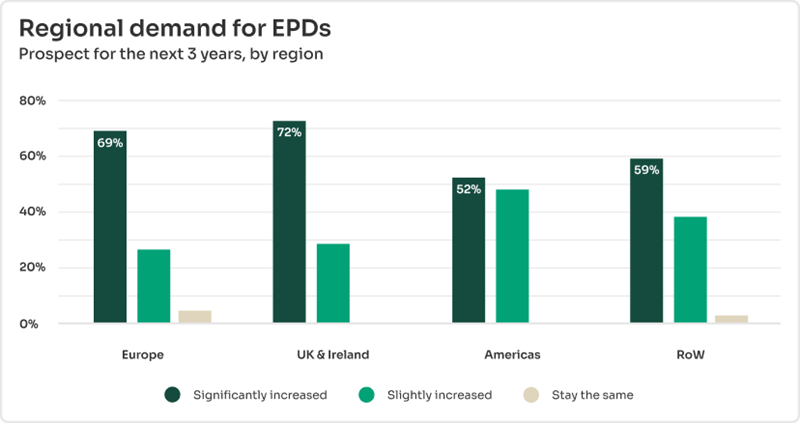
HELSINKI, Finland (May 6th, 2026) One Click LCA, the leading sustainability platform for construction and manufacturing, today released its 2026 Carbon Experts Report. The report shows that demand for verified environmental product data is rising rapidly across the global construction industry. The study finds that 97% of construction professionals expect demand for Environmental Product Declarations (EPDs) to increase within the next three years, while 90% of AEC professionals already prefer products with EPDs when specifying materials for projects.
The findings suggest that the next phase of construction decarbonization will depend on scaling reliable product data across the value chain. Both manufacturers and AEC professionals estimate that transparent product data could reduce embodied carbon in construction up to 30%, demonstrating the significant climate impact of scaling environmental transparency across the supply chain. By expanding EPD coverage and improving digital data exchange, manufacturers can not only unlock new commercial opportunities but also enable meaningful emissions reductions across projects worldwide.
The report also highlights a growing opportunity gap between manufacturers and the AEC sector. While product-level environmental data is increasingly shaping design and procurement decisions, many project teams still lack access to verified data for key materials and product categories, with 1/3 of professionals reporting a lack of data in several categories. One of the biggest gaps lies in mechanical, electrical, and plumbing (MEP) products, which are critical to decarbonization efforts, as MEP systems can make up 15-50% of a building’s embodied carbon.
Environmental product data becomes a competitive advantage.
As embodied carbon becomes a central concern in construction, EPDs are increasingly shifting from compliance tools to market assets. The study shows that 65% of AEC professionals now require EPDs for all or most projects. In comparison, 90% say they prefer products backed by EPDs because they help meet sustainability requirements and strengthen bids for environmentally driven projects.
Manufacturers recognize this shift. More than half view environmental product data as a competitive advantage and an important factor for market access, reflecting the growing role of carbon transparency in procurement decisions. However, the report highlights a persistent disconnect: demand from project teams is growing faster than manufacturers’ perceptions of that demand, particularly in mechanical, electrical, and plumbing (MEP) products, where verified environmental data remains limited.
Manufacturers hold the key to construction decarbonization.
With buildings responsible for roughly 40% of global carbon emissions, the construction supply chain represents one of the largest opportunities to accelerate climate action. Manufacturers sit at the foundation of this supply chain, and their ability to provide verified product data is crucial to enabling low-carbon design and procurement decisions. More than half of the manufacturers believe they can reduce carbon more than 10%, even over 30%,
Yet the report notes that the greatest carbon-reduction potential lies in the early design stages, when material choices are still flexible. Without reliable product data available early in the process, many of these opportunities remain unrealized.
56% of manufacturers now see product-level EPDs as a competitive advantage, a marked change from the 40% in the 2025 report. Yet the discrepancy between AEC demand and manufacturer sentiment persists, suggesting that suppliers with environmental data will have a competitive edge in the years to come.
Technology and automation accelerate progress, yet barriers remain.
Both manufacturers and AEC professionals expect automation and AI-assisted tools to play a major role in scaling environmental assessments across the industry. Respondents highlighted technologies such as automated data mapping, API integrations between enterprise systems, and AI-assisted data matching as key approaches to reducing the time and complexity required to produce LCAs and EPDs. These technologies could help manufacturers scale environmental data creation across entire product portfolios while enabling project teams to integrate carbon analysis directly into design workflows.
Yet, despite growing awareness and increasing demand, the report identifies several barriers slowing progress toward net-zero construction. Manufacturers continue to cite cost, complexity, and verification requirements as major obstacles to producing EPDs at scale. At the same time, AEC professionals report that a lack of verified product data remains one of the most limiting factors when conducting whole-building carbon assessments.
Regulatory progress is helping drive change, particularly in Europe, where policies such as the recent Industrial Accelerator Act (IAA), revised Energy Performance of Buildings Directive (EPBD), the Construction Products Regulation (CPR), and the Carbon Border Adjustment Mechanism (CBAM) are strengthening demand for reliable product-level environmental data.
“For years, the construction industry has talked about regulatory requirements as the main driver for EPD adoption, but today, having this data has become a competitive requirement. Materials manufacturers who have EPD data for their portfolio are the ones who will continue to gain market share, and further carbon reductions depend on this product-level data” says Panu Pasanen, Founder & CEO of One Click LCA.
With demand for verified environmental data accelerating, the report concludes that stronger collaboration between manufacturers, designers, regulators, and technology providers will be essential to transform rising market expectations into measurable carbon reductions in the built environment.
###
For additional information:
Álvaro Martos, Senior Sustainability Communications Specialist
One Click LCA
alvaro.martos@oneclicklca.com
About One Click LCA
Used in 170+ countries, One Click LCA is the world-leading end-to-end sustainability platform for construction and manufacturing. The AI-powered software decarbonizes and drives sustainability across the construction value chain with scientific, easy-to-use, automated life cycle assessment (LCA) and environmental product declarations (EPDs) to calculate and reduce the environmental impacts of building, infrastructure, and renovation projects and products. The platform also allows assessment of circularity, life cycle cost, and biodiversity.
One Click LCA is used by blue-chip enterprises like Skanska, WSP, Foster+Partners, LafargeHolcim, ArcelorMittal, Arcadis, Geberit, and Saint-Gobain, among others. It offers a unique global database with +300,000 LCA datasets; supports +80 standards and certifications, including LEED, BREEAM, GRESB and other national regulations; and seamlessly integrates with +20 of the most widely used BIM software tools, including Autodesk Revit®, Tekla Structures® and Bentley iTwin®. One Click LCA was founded in Helsinki, Finland in 2001, with a team of +200 people on all continents. Learn more at: oneclicklca.com.
Tags: