2500 year old Bronze Age neck rings discovered in grave in Marby
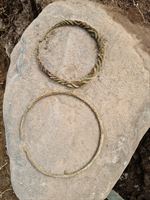
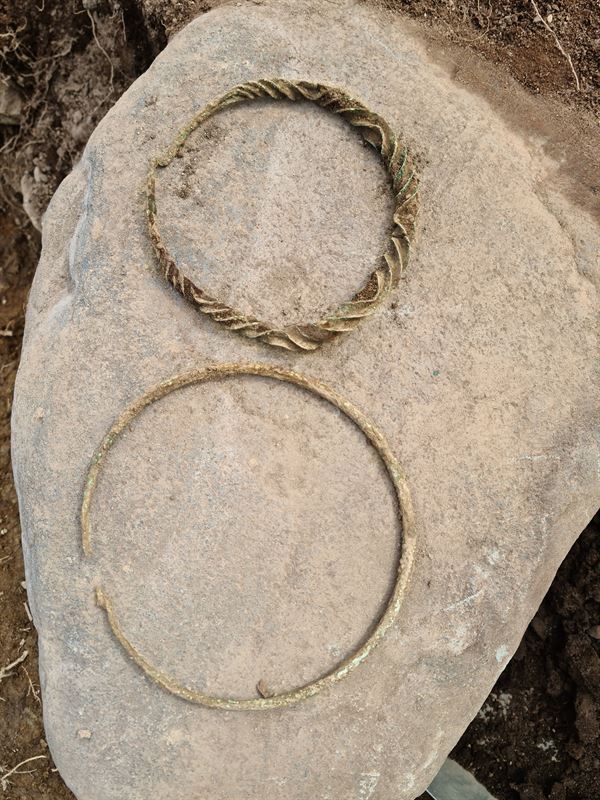
Two unusual Bronze Age neck rings have been discovered during an archaeological excavation in Marby, east of Norrköping, Sweden. The rings, more than 2,500 years old, were likely deposited as ritual offerings — and the find may be unique in its context.
– Finding them in a setting like this is highly unusual, perhaps unique, says Alf Ericsson of Archaeologists at the National Historical Museums.
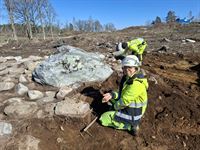
At first glance, the site looks like an ordinary wooded hillside in the sun. But beneath the ground lie traces of the past and the people who lived here thousands of years ago.
Over the past few weeks, archaeologists have investigated parts of a larger archaeological landscape east of Norrköping, containing graves, rock carvings and settlement remains from the Late Bronze Age (c. 1100–500 BC). At the time, the area was located beside a bay close to the sea. The excavation is being carried out ahead of planned housing development in the area.
During the excavation, archaeologists made an unexpected discovery.
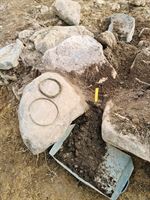
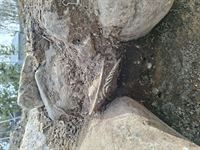
In one of the graves — a stone setting with a central block — cremated human bones had been deposited both in an urn and in small pits in the ground. Additional bones had also been scattered throughout the grave’s stone and soil fill. Near the eastern edge of the grave, separate from the burials themselves, two beautifully preserved bronze neck rings were found wedged between stones.
The neck rings are known as wendel rings, a rare type of bronze ornament dating to the final phase of the Bronze Age. They are characterized by their twisted form, where the cast bronze alternates between right- and left-handed twists.
The larger ring is thinner, while the smaller one is thicker and more heavily profiled, explains Alf Ericsson, archaeologist and project manager.
– Wendel rings are relatively rare finds. They are often discovered in hoards together with other objects, typically in wetlands such as bogs or marshes. Near our excavation site, in Häradshammar in Östergötland, two wendel rings were previously found deposited in a bog. But finding two neck rings placed together inside a grave monument containing burials is extremely unusual — perhaps unique.
Previous finds suggest that around ten similar rings have been discovered in Östergötland. The neck rings were most likely worn by women and probably functioned as status symbols.
– We never expected to find anything like this. We still haven’t fully taken it in, says Alf Ericsson.
Osteological analysis may reveal how many individuals were buried in the stone setting.
The people who lived here during the Bronze Age belonged to a complex and symbolically rich culture. Archaeologists also uncovered house remains and investigated two burnt mounds built up from fire-cracked stones.
For a long time, burnt mounds were interpreted simply as waste heaps connected to cooking and everyday domestic life during the Bronze Age. However, human bones and bronze objects are sometimes found within them, suggesting they may also have served ritual or ceremonial purposes.
At the Marby excavation, one of the burnt mounds had been transformed into a grave monument already during the Bronze Age — something considered highly unusual. The second mound contained large quantities of fire-cracked stone, pottery fragments and pieces of clay used as daub in the wall of a fire-damaged house. At the base of the mound, archaeologists also uncovered two concentric stone circles, a feature otherwise associated with grave monuments from this period.
For more information, please contact:
Alf Ericsson, Arkeologerna/The Archaeologists, alf.ericsson@arkeologerna.com +46 (0)10-480 81 46, 076-128 41 46
Press contact: Ninna Bengtsson, +46 (0) 10-480 80 76, +46 (0)702-11 70 92, ninna.bengtsson@arkeologerna.com
Arkeologerna
Arkeologerna, Statens historiska museer, Box 5428, 114 84 Stockholm. Tfn 010-480 80 00. www.arkeologerna.com
Taggar: