Rare 5,000-year-old dog burial unearthed in Sweden
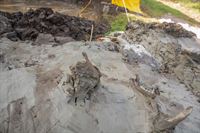
Archaeologists from the Swedish National Historical Museums have uncovered a rare and exceptionally well-preserved Stone Age dog burial in a bog near Järna, southwest of Stockholm. The find dates back around 5,000 years and includes the complete skeleton of a dog deliberately deposited together with a finely polished bone dagger.
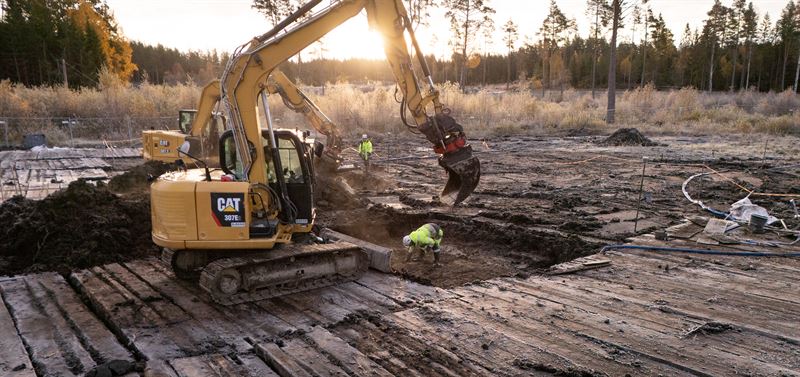
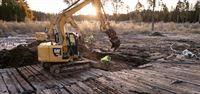
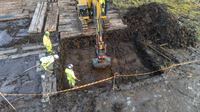
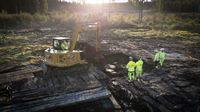
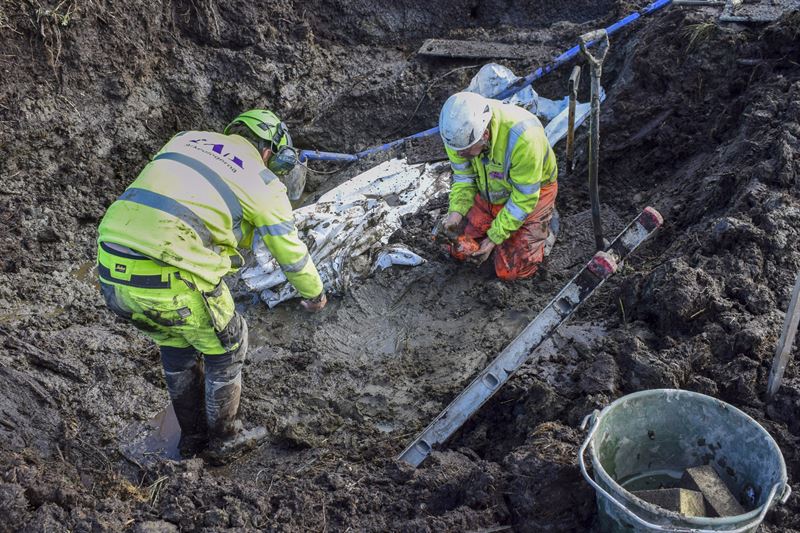
An unusual and exceptionally well-preserved discovery has been made in Logsjömossen, in Gerstaberg outside Järna, where archaeologists have been investigating ancient remains during the autumn in connection with construction works for the Ostlänken railway. In the bottom sediments, a 5,000-year-old buried dog was found – deposited together with a
25-centimetre-long bone dagger.
Several thousand years ago, the 3,500-square-metre area looked very different. At that time, the bog was a shimmering lake used for fishing.
“Finding an intact dog from this period is very rare, and the fact that it was deposited together with a bone dagger is almost unique,” says Linus Hagberg, archaeologist and project manager at Arkeologerna, Statens historiska museer.
The dog was a large and powerful male, with a shoulder height of 52 centimetres. It was approximately 3–6 years old and had lived an active life. The skull was crushed, and in direct connection to the paws lay a finely polished, 25-centimetre-long dagger made from bone from elk or red deer. The dog was likely placed in some kind of skin bag or container with stones.
“It had been deliberately lowered to a depth of 1.5 metres and about 30–40 metres out into the lake. The use of dogs in ritual practices during this period is a known phenomenon,” says Linus Hagberg.
He points out that scientific analyses such as radiocarbon dating, isotope analysis and DNA analyses will be able to reveal more details.
“For example, we can determine when the dog lived, its age, and what it ate. The dog’s life history can in turn tell us more about how the people who owned the dog lived and sustained themselves,” says Linus Hagberg.
The excavation was carried out in parallel with the construction of a pile foundation for the upcoming railway embankment. The water-rich gyttja layers made the work logistically challenging, but close cooperation between archaeologists and contractors enabled safe and thorough documentation.
“The collaboration has worked very well despite difficult conditions,” says Magnus Johansson, project manager for the Ostlänken Archaeological Project.
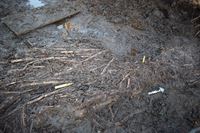
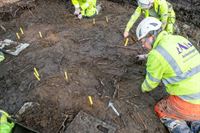
The archaeologists have also found well-preserved wooden material dating to the periods 3300–2900 BC and 2900–2600 BC, including worked standing stakes driven into the lakebed and posts that may have formed parts of wodden platforms along the shore. Other finds include deliberately placed stones that likely functioned as anchors and net sinkers, and a two-metre-long construction made of interwoven wooden withies – an ancient fishing trap. In addition, traces of human movement out in the lake were discovered.
“Adjacent to the fish trap are trampled areas where it is possible to see that people have stood and moved about on the lakebed. These appear as patches in the mud. Perhaps they were checking their traps,” says Linus Hagberg.
Further analysis work and conservation of the finds will now follow before the final report is published.
For more information, please contact:
Linus Hagberg, Archaeologist, Project Manager, Arkeologerna, Statens historiska museer. Phone: +46 (0)10-480 81 52.
Email: linus.hagberg@arkeologerna.com
Press contact: Ninna Bengtsson, Arkeologerna. Phone: +46 (0)10-480 80 76, +46 (0)702-11 70 92
Email: ninna.bengtsson@arkeologerna.com
For more information about the Ostlänken project:
Magnus Johansson, Archaeology Project Manager, Ostlänken, The Swedish Transport Administration.
Phone: +46 (0)10-124 42 86
Email: magnus.r.johansson@trafikverket.se
Arkeologerna
Arkeologerna, Statens historiska museer, Box 5428, 114 84 Stockholm. Tfn +46 (0)10-480 80 00. www.arkeologerna.com
Taggar: