
Future Fika: A Swedish “Blood Brownie” Tackles Iron Deficiency and Food Waste
Blood is one of the most nutrient-dense foods we have – yet more than 95% of all cattle blood in Sweden goes to waste. At the same time, nearly one in three women suffer from iron deficiency. Now, Axfoundation and Pressbyrån’s Innovation Lab PBX together with IVL Swedish Environmental Research Institute and several research and development partners, are showcasing how overlooked food streams can become part of the solution. First up: an iron-rich Swedish innovation – the “Blood Brownie,” baked with cattle blood, whole grains, and of course, chocolate.

A brownie with bigger ambitions than just tasting good: where iron deficiency, food waste, and chocolate meet in a research project on the future of food. Photo: Axfoundation
The blood brownie is the result of the research and innovation project “Blood & Turnip”, which maps how Swedish raw materials otherwise discarded can be transformed into new, healthy, and sustainable foods. A striking example is cattle blood: today it mainly ends up as biogas or animal feed due to lack of demand in the food market – despite its high content of heme iron, the form of iron most easily absorbed by humans.
“Iron deficiency is common, especially among young women. We believe in boosting everyday foods with blood, which is rich in absorbable iron – but it must be foods people actually want to eat,” says Veronica Öhrvik, Project Manager within Future Food at Axfoundation.
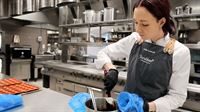
Chefs and nutrition experts have worked closely with researchers and sensory specialists at Torsåker Farm, Axfoundation’s development center for sustainable solutions, to experiment with blood as an ingredient. The Blood Brownie – baked with 20% cattle blood, whole-grain rye flour, and Fairtrade cocoa – was chosen because chocolate’s taste and color complement the properties of blood. Along the way, both adults and children taste-tested various versions, responding with surprising positivity, even when the label clearly stated “blood.”
“Blood behaves much like eggs and coagulates with heat. In our experiments we also found that it gives chocolate a deeper, richer flavor. As a bonus, it masks the dark coloring of blood that can otherwise turn foods pitch-black. Pancakes with blood instead of eggs work fine too, but people aren’t used to eating black pancakes,” explains Sofia Lundvall, chef and sensory specialist at Torsåker Farm.
Two mini-brownies cover 25% of a woman’s daily iron needs. At the same time, the brownie highlights an important principle: food should be used as food – not downgraded to feed, biogas, or waste. Since beef is among the most climate-intensive foods, it becomes even more crucial to utilize the whole animal. By taking anatomical responsibility, partners across the food chain are working to reduce food waste long before food even reaches the store – and to show how our food system can become healthier, more resource-efficient, and more circular.
The Blood Brownie is the first product from the Blood & Turnip project to be tested in a real retail environment, starting at Pressbyrån’s experimental test lab PBX, located in central Stockholm. Pressbyrån is part of Reitan Convenience, which also operates Narvesen in Norway, R-kioski in Finland, and 7-Eleven in Denmark.
“With Pressbyrån PBX we want to explore more sustainable ways forward for future on-the-go products. Through our collaboration with Axfoundation, we want to show how food waste can be transformed into a delicious fika item that also addresses a pressing public health issue. The Blood Brownie is exactly the typeof innovation we want to pilot at PBX,” says Linnéa Borgström, HR and Sustainability Director at Reitan Convenience Sweden, Denmark and Norway.
The Blood & Turnip project is led by IVL Swedish Environmental Research Institute in collaboration with Axfoundation, Matsvinnet.se, Ipsos, and the Swedish University of Agricultural Sciences (SLU).
Five facts about food waste, nutrition, and the Blood Brownie
- In Sweden, 38 kg of food waste per person is generated before food even reaches the store shelf. (Swedish Environmental Protection Agency)
- Nearly half of slaughter by-products from cattle and pigs that could become food are instead turned into biogas or feed. Only 3% of cattle blood from slaughter is currently used in food. (Swedish Board of Agriculture)
- Nearly one-third of women of childbearing age and teenage girls in Sweden are estimated to have iron deficiency. (Nutritionsfakta)
- 9 out of 10 Swedes eat too little whole grain. (Swedish National Food Agency)
- The Blood Brownie contains 20% cattle blood, replacing eggs, and whole-grain rye flour instead of refined wheat. A 20 g brownie contains 1.9 mg iron, equal to 13% of the recommended daily intake for women of childbearing age. (Axfoundation)
Contact
- Linda Andersson, Head of Communications, Axfoundation +46 (0)73 - 087 15 70, linda.andersson@axfoundation.se
- Veronica Öhrvik, Project Manager at Future Food, Axfoundation, +46 (0)73-055 38 51, veronica.ohrvik@axfoundation.se
- Sofia Lundvall, chef and sensory specialist at Torsåker farm, Axfoundation, +46 (0)76 114 78 43, sofia.lundvall@axfoundation.se
- Harris Lukeman, PR- & Communications Manager, Reitan Convenience Sweden harris.lukeman@reitanconvenience.se
Axfoundation is an independent, non-profit organization working practically and concretely towards building a sustainable society. Axfoundation develops practical solutions to complex sustainability challenges within Future Food and Future Materials. Believing strongly in business as a driving force for change and in broad collaboration between relevant actors in society, Axfoundation collaborates with over 300 partners across sectors and industries. Together, the organization tackles local and global sustainability challenges based on practical issues related to the things we buy, the food we eat and the resources we use. Torsåker Farm is Axfoundation's development center for future food and materials. Here, we aim to accelerate the transition to sustainable materials and food systems - for the benefit of the climate, the environment, and public health. Together with researchers and practitioners, we take on complex challenges and develop concrete solutions.
Tags: