Fazer publishes wartime frontline letters preserved in its archives for over 85 years
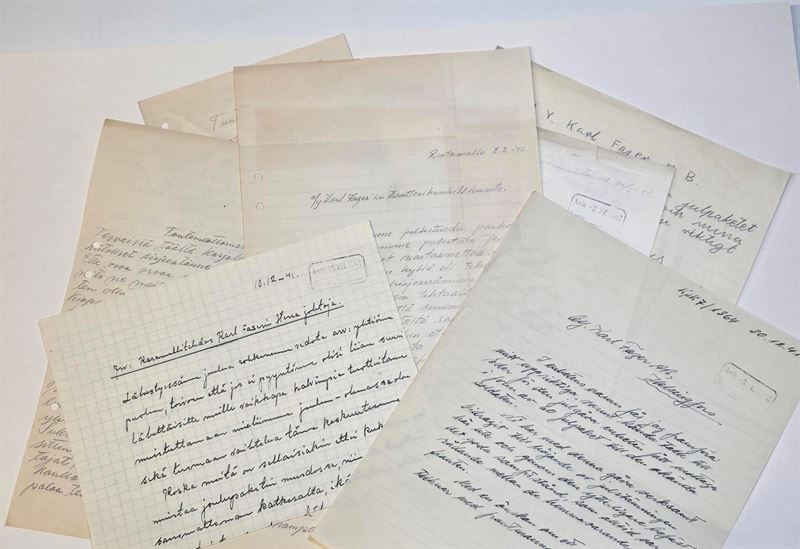
Fazer is releasing a collection of field post letters sent by Finnish soldiers and Lottas, members of the Lotta Svärd organisation, from the front during the war years 1939–1945. These letters, preserved in the company’s archives for more than 85 years, are now being published digitally for the first time as part of a culturally and historically significant veteran heritage.
“During the war, we received hundreds of letters from the front – letters expressing gratitude for deliveries and requesting products to ease homesickness and strengthen fighting spirit. Despite the harsh conditions, the letters convey humor. It feels good to think that with our small contribution we brought hope to the frontline. In addition to confectionery, wool garments knitted by our employees were also sent to the front,” says Liisa Eerola, Communications Director at Fazer Confectionery.
This previously unpublished field post material offers a unique glimpse into the lives and community spirit of the Finns during the war years. In total, well over one billion items – letters, cards, and parcels – were delivered through the field post system during the war.
“Field post was a messenger of hope and connection. Correspondence was a vital means of survival, keeping up the spirits of soldiers and families and bringing hope during the harshest war years,” says Sakari Martimo, Executive Director of the Oak Leaf Heritage Association.
“Preserved field post is a culturally and historically valuable part of the veteran heritage. The letters provide researchers and families with important insights into social relationships, family history, wartime experiences, and the story of Finnish resilience,” Martimo continues.
103-year-old signal Lotta Helka Visuri recalls the importance of field post
Lottas trained in office and communication work played a key role in sorting and delivering field post. Helka Visuri, 103, who was named Lotta Svärd Foundation’s Lotta of the Year 2025, remembers the significance of field post.
“Oh, the joy when my mother received a letter from my brothers at the front. We wrote about everyday things, life at home, and youth stories – even funny and cheerful moments. That’s what was longed for in the midst of war: knowing that someone was waiting at home. Field post brought determination to the front,” Visuri says.
Visuri, living in Pieksämäki, made her Lotta pledge at the age of 17 and served as a signal Lotta. Before Christmas, packages sent to the front were filled with books, sweets, pastries, canned goods, and handicrafts.
“We Lottas and junior Lottas also wrote and sent packages to unknown soldiers, so that even those who had no one writing to them would receive mail. It’s wonderful that some frontline letters have been preserved; my own letters have been lost along the way. Field post tells our history, it’s important to remember,” Visuri says.
The field post letters, written in Finnish and Swedish, can be read on Fazer’s website.
Fazer’s operations during the war years
The war years 1939–1944 affected Fazer in many ways:
- 75 factory employees were called to military service during the Winter and Continuation Wars; 18 never returned home.
- Fazer’s biscuit factory in Hanko was evacuated to Helsinki in spring 1940, and production facilities began making macaroni and biscuits, among other items, for the Finnish Defence Forces.
- The windows of the café on Kluuvikatu were protected with sandbags and boards, but the café remained open throughout the war. Kalastajatorppa, owned by Fazer, was converted into a military hospital.
- When cocoa could no longer be imported to Finland, chocolate production ceased in 1940.
- Using beet syrup and roasted soybeans, Fazer produced Ravitol, which tasted “remotely like cocoa”.
- Due to sugar shortages, it was no longer possible to produce confectionery during the second half of 1943, except for a small batch made for the Lotta Svärd organisation for Christmas 1943 by order of the Ministry of Supply.
- Licorice production stopped during the war. It resumed at the end of 1942 but ceased again in autumn 1944, when raw licorice was handed over for medical purposes by government order.
- In 1947, Fazer introduced Pax pastilles, inspired by the Paris Peace Treaty, and in 1949 chocolate rationing ended, allowing classic products to return to production.
Media Contacts:
Liisa Eerola, Director, Communications, Fazer Confectionery, tel. +358 44 710 8860, liisa.eerola@fazer.com
Fazer Media desk tel. +358 40 668 2998 (weekdays 8:00–16:00 EET), media@fazer.com
Fazer Group
Fazer, The Food Experience Company, enables people to enjoy the best moments of their day. Our mission, Food with a purpose, builds on our strong more than 130-year heritage, consumer first approach and innovations to create the sustainable food solutions of the future. With our dedicated team of approximately 5,000 professionals, we focus on fast-moving consumer goods and our direct-to-consumer business in Northern Europe, and beyond with exports to more than 40 countries. Fazer’s operations comply with its Code of Conduct that is based on the Group’s values and the UN Global Compact. In 2024, Fazer Group had net sales of 1.200 million euros.
Northern Magic. Made Real.